The Sun Tarot Card Meaning: Upright, Reversed and Symbolism
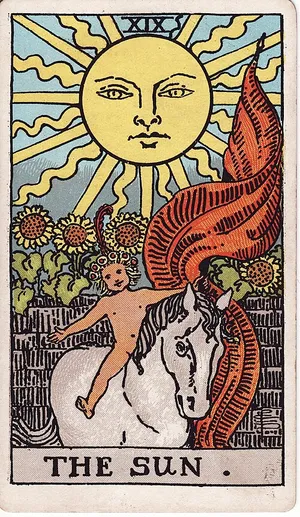

The Sun is card XIX (19) of the 22 Major Arcana in the Rider–Waite–Smith tarot, drawn by Pamela Colman Smith and published in London in 1909. It shows a great sun with a human face shining over a stone wall and a row of sunflowers, while a naked child rides a white horse in front of them with a red banner streaming alongside. Upright, it is read as warmth, joy and things seen clearly in daylight; reversed, as the same brightness in a smaller or clouded form.
Key facts
- Number and place: XIX, between The Moon (XVIII) and Judgement (XX).
- Other names: none in common use; the card is printed THE SUN.
- Upright in one line: joy, vitality, clarity, confidence.
- Reversed in one line: the same light dimmed, delayed or harder to feel.
- Waite’s own key words (1910): material happiness, fortunate marriage, contentment.
What the picture shows
The sun fills the top third of the card. It is a pale yellow disc with a calm human face, looking straight out at you, and its rays alternate between straight bands and wavy ones, reaching to the edges of the sky. Below it, a grey wall of stone blocks runs across the card. Four tall sunflowers stand behind the wall, three on the left and one on the right, their heads above the stones and their green leaves hanging over the top.
In front of the wall a small naked child sits on a white horse, with no saddle or reins in sight. The child’s arms are spread wide, one stretched out to your left, and the face is open and smiling. On the head is a wreath of small flowers with a single red feather standing up from it. A long red banner billows out on the right from a staff at the top of the picture and falls down past the horse’s head, which sits at the right and faces towards the viewer. Waite describes the child “mounted on a white horse and displaying a red standard”. Smith’s monogram is in the lower right corner, on the wall.
Waite does not explain the sunflowers or the feather; later commentators often read the sunflowers as living things turned towards the light, and the feather as a link to the one worn by The Fool. His text does mention a walled garden, as shown below.
Waite’s meanings in 1910
In the Part III list of divinatory meanings in The Pictorial Key to the Tarot, the Sun has a brief entry:
“Material happiness, fortunate marriage, contentment. Reversed: The same in a lesser sense.”
These are the keywords of an early twentieth-century fortune-telling list. The reversed line is notably mild: the card’s meaning is not turned round, only reduced.
His Part II reading is about light of two kinds. He says the card shows “the great and holy light which goes before the endless procession of humanity, coming out from the walled garden of the sensitive life and passing on the journey home”. Readers often connect that “walled garden” with the stone wall the child rides in front of. The card, he writes, signifies “the transit from the manifest light of this world, represented by the glorious sun of earth, to the light of the world to come”. He then adds a second key: “The sun is that of consciousness in the spirit—the direct as the antithesis of the reflected light.” The child stands for “simplicity and innocence in the sense of wisdom”, and “in that innocence, he signifies the restored world”. His closing sentence, in which the renewed mind “leads forth the animal nature in a state of perfect conformity”, is often read as a gloss on the child riding the horse.
How the card is usually read today
One common modern reading treats the Sun as a card of clear daylight: warmth, energy and the ease of being seen as you are. After the uncertainty of the Moon, things are visible again. Take it as a prompt to notice what is good, not as a promise.
Upright. Readers often connect it with enjoyment, confidence, vitality, creative energy, or the simple pleasure of something going well. Many point to the child: the card can be read as an invitation to approach things openly and playfully, without armour.
Reversed. Waite’s “The same in a lesser sense” is still the core of many readings: the good feeling is there, but muted. Later readings add a cloud passing over the sun, joy that is hard to feel at the moment, or brightness that turns into overconfidence. Some read it as a reminder that cheerfulness put on for others is not the same as the warmth on the card.
Some questions to sit with:
- What in my life is going well, and have I let myself notice it?
- Where could I be more open and less guarded?
- If I saw this situation in plain daylight, what would be obvious?
Upright and reversed at a glance
| Upright | Reversed | |
|---|---|---|
| Waite, 1910 | Material happiness, fortunate marriage, contentment | The same in a lesser sense |
| Common reading today | Joy, vitality, clarity, confidence | Joy muted or clouded; overconfidence |
| A question to ask | What is clearly good here? | What is dimming the light for me? |
The Sun in a spread
The same card can raise different questions by position.
- Three cards (Past, Present, Future). As the Past, it can point back to a time of confidence or happiness that still gives you strength. In the Present, it asks what is going well and whether you are making room to enjoy it. In the Future position, readers usually take it as an encouragement to look for what is clear and simple, not as a promise of a good outcome.
- Celtic cross. In the Crown position, the Sun may show what you are aiming at: openness, recognition, or simply feeling well. In the Challenge position, it can point to the strain of always having to appear bright, or to an obvious truth you have been avoiding. In the Outcome position, many readers look at the earlier cards to see what the clearer view rests on.
The positions of both spreads and the names of all 78 cards are in the tarot glossary; where the deck and its pictures come from is in the 1909 Rider–Waite–Smith tarot.
Cards often read next to the Sun
- The Moon (XVIII), the card before it: in this card’s Part II entry, Waite calls the Sun’s light “the direct as the antithesis of the reflected light”, and readers often take the reflected light as the Moon’s.
- Judgement (XX), the card after it: from clear daylight to a summons and an awakening.
- The Star (XVII): with the Moon and the Sun, one of three sky cards in a row, from starlight to full day.
- The Fool (0): later commentators often compare the Sun’s child with the Fool’s innocence and open start.
In HeyFate, each card you draw is turned upright or reversed at random with even odds, and an AI model writes the reading. This page is the reference behind the card, not a reading of your own question.
Sources
- A. E. Waite, The Pictorial Key to the Tarot, Part II, “XIX. The Sun” (Wikisource, from the 1922 reprint)
- A. E. Waite, The Pictorial Key to the Tarot, Part III, §3, the divinatory meanings of the Greater Arcana (Wikisource, from the 1922 reprint)
- Wikimedia Commons: RWS Tarot 19 Sun.jpg (Pam-A scan, public domain)
AI-generated content, for reference only; not medical, legal, financial or psychological advice. These methods come from cultural traditions, and HeyFate offers them for cultural interest, entertainment and self-reflection.