The Moon Tarot Card Meaning: Upright, Reversed and Symbolism
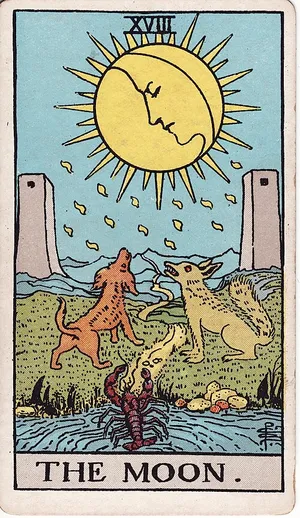

The Moon is card XVIII (18) of the 22 Major Arcana in the Rider–Waite–Smith tarot, drawn by Pamela Colman Smith and published in London in 1909. It shows a moon with a face whose eyes are closed, above two towers, a dog and a wolf baying at it, and a crayfish crawling out of a pool, with a path running between them all into the distance. Upright, it is read as uncertainty, imagination and things not yet clear; reversed, as that confusion easing, or as unease that is hard to name.
Key facts
- Number and place: XVIII, between The Star (XVII) and The Sun (XIX).
- Other names: none in common use; the card is printed THE MOON.
- Upright in one line: uncertainty, dreams and intuition, a path walked by reflected light.
- Reversed in one line: the fog thinning, or worries that stay vague and unspoken.
- Waite’s own key words (1910): hidden enemies, danger, calumny, darkness, terror, deception, occult forces, error.
What the picture shows
A large yellow disc fills the top of the card, edged with long and short rays that alternate all the way round. Inside it a thin crescent is outlined, and within the crescent is a face in profile with its eyes closed, calm and turned slightly downward. Waite draws attention to two details here: the moon is “increasing on what is called the side of mercy, to the right of the observer”, and it has “sixteen chief and sixteen secondary rays”. Below the disc, small yellow drops shaped like flames or tears fall towards the ground. Waite calls this falling “the dew of thought”; later commentators often read the drops as the Hebrew letter yod.
A plain grey tower stands on each side, each with a single small dark window near the top. Between them the land opens onto blue mountains. In the middle ground two animals lift their heads towards the moon with open mouths: an orange dog on the left and a paler, wolf-like animal on the right. Waite refers to them simply as the “dog and wolf” and does not say which is which.
At the bottom, in a pool of water, a dark red crayfish crawls up onto the bank. From the edge of the pool a pale path starts out, passes between the two animals and winds on between the towers towards the hills. Stones and small dark plants line the shore. Smith’s monogram is at the lower right.
Waite’s meanings in 1910
Part III of The Pictorial Key to the Tarot gives this divinatory meaning for the card:
“Hidden enemies, danger, calumny, darkness, terror, deception, occult forces, error. Reversed: Instability, inconstancy, silence, lesser degrees of deception and error.”
They are worth reading as history: the fortune-telling vocabulary of his day, much darker in tone than his own symbolic reading of the same card.
In Part II he says the card “represents life of the imagination apart from life of the spirit”. The path between the towers is “the issue into the unknown”, and the dog and wolf are “the fears of the natural mind in the presence of that place of exit, when there is only reflected light to guide it”. The creature from the pool stands for “the nameless and hideous tendency which is lower than the savage beast”: it “strives to attain manifestation” by crawling onto land, “but as a rule it sinks back whence it came”. His reading ends on a calm note. The face above “directs a calm gaze upon the unrest below”, the dew falls, and “the message is: Peace, be still”.
How the card is usually read today
One common modern reading treats the Moon as the card of not knowing: walking a path you can only partly see, with imagination filling in the gaps, sometimes helpfully and sometimes not. Its themes are dreams, intuition, mixed signals, and feelings that rise from below before they can be put into words. Like every card here, it offers a way of looking, not a forecast.
Upright. Readers often take it as a time when facts are incomplete and it is easy to misread a situation, or to project fears onto it. Some stress the other side: the Moon can also mean trusting intuition, paying attention to dreams, or letting a feeling take shape before acting on it.
Reversed. Waite’s reversed line, “lesser degrees of deception and error”, already softens the upright list. Later readings add that the reversed Moon can show confusion clearing, a misunderstanding coming to light, or, in the other direction, anxiety that stays below the surface without a clear cause.
Some questions to sit with:
- What do I actually know here, and what am I filling in?
- Which of my fears are about the situation, and which are older than it?
- What is my intuition telling me, quietly, that I have not yet put into words?
Upright and reversed at a glance
| Upright | Reversed | |
|---|---|---|
| Waite, 1910 | Hidden enemies, danger, darkness, deception, occult forces, error | Instability, inconstancy, silence; lesser deception and error |
| Common reading today | Uncertainty, imagination, intuition; things not yet clear | Confusion lifting; or a vague unease beneath the surface |
| A question to ask | What am I seeing by reflected light only? | What has become clearer, and what is still unspoken? |
The Moon in a spread
How the card is read depends on where it falls.
- Three cards (Past, Present, Future). In the Past, it can point to a period of confusion whose impressions still colour how you see things. In the Present, it asks where you are guessing rather than knowing. As the Future, readers usually take it as a prompt to check your information and listen to your intuition before deciding, not as a sign that something is hidden from you.
- Celtic cross. In the Root position, the Moon may invite reflection on feelings or dreams that sit underneath the question. In the Challenge position, it can point to uncertainty itself: the difficulty may be that the full picture is not yet available. In the Outcome position, many readers read it together with the cards beside it to see whether they bring more light.
The positions of both spreads and the names of all 78 cards are in the tarot glossary; where the deck and its pictures come from is in the 1909 Rider–Waite–Smith tarot.
Cards often read next to the Moon
- The Star (XVII), the card before it: a clear night and open hope, where the Moon’s night is uncertain.
- The Sun (XIX), the card after it: in Part II, “XIX. The Sun”, Waite describes the Sun’s light as “the direct as the antithesis of the reflected light”.
- The High Priestess (II): later commentators often link her with the moon and with hidden knowledge and intuition.
- The Tower (XVI): both cards show towers: there one is struck by lightning, while here two stand on either side of the way into the unknown.
In HeyFate, each card you draw is turned upright or reversed at random with even odds, and an AI model writes the reading. This page is the reference behind the card, not a reading of your own question.
Sources
- A. E. Waite, The Pictorial Key to the Tarot, Part II, “XVIII. The Moon” (Wikisource, from the 1922 reprint)
- A. E. Waite, The Pictorial Key to the Tarot, Part III, §3, the divinatory meanings of the Greater Arcana (Wikisource, from the 1922 reprint)
- Wikimedia Commons: RWS Tarot 18 Moon.jpg (Pam-A scan, public domain)
AI-generated content, for reference only; not medical, legal, financial or psychological advice. These methods come from cultural traditions, and HeyFate offers them for cultural interest, entertainment and self-reflection.