The World Tarot Card Meaning: Upright, Reversed and Symbolism
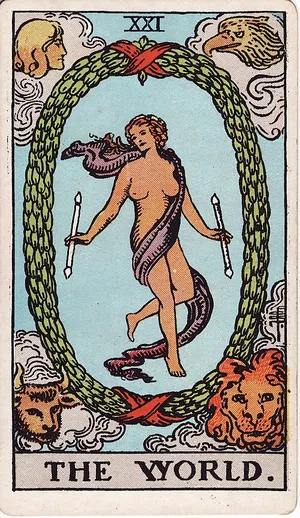

The World is card XXI (21) of the 22 Major Arcana in the Rider–Waite–Smith tarot, drawn by Pamela Colman Smith and published in London in 1909, and the last card of the sequence. It shows a dancing figure inside a large oval wreath, holding a wand in each hand, with four heads in the clouds at the corners: a human, an eagle, a bull and a lion. Upright, it is read as completion, wholeness and a cycle brought to its end; reversed, as something left unfinished, or movement that has stalled.
Key facts
- Number and place: XXI, the final card, after Judgement (XX). In many readings the sequence then returns to The Fool (0).
- Other names: older French decks call it Le Monde. In Part I, Waite heads it “The World, the Universe, or Time”, and in Part II he mentions that it “has been called the Crown of the Magi”.
- Upright in one line: completion, integration, arriving at the end of a stage.
- Reversed in one line: loose ends, a delay before closure, a sense of being stuck.
- Waite’s own key words (1910): assured success, recompense, voyage, route, emigration, flight, change of place.
What the picture shows
Most of the card is taken up by a tall oval wreath of green leaves, tied at the top and at the bottom with red ribbons that cross over each other. Inside it, against a pale blue sky, a woman with reddish-brown hair seems to dance or float. She is naked apart from a long violet scarf that billows out from her shoulder, wraps diagonally across her body and trails away below her feet. She holds a short white wand in each hand, with tapered, pointed ends. One leg is straight and the other bends behind it, crossing at the knee; later commentators often compare this with the crossed legs of The Hanged Man.
In each corner a head looks out from a white cloud: a fair-haired human at the upper left, an eagle at the upper right, a bull at the lower left and a lion at the lower right. Waite does not explain them in Part II, but in Part I he identifies them as “The four living creatures of the Apocalypse and Ezekiel’s vision, attributed to the evangelists in Christian symbolism”. Later commentators also read them as the four fixed signs of the zodiac: Aquarius, Scorpio, Taurus and Leo. The same four creatures, winged and holding books, sit in the corners of Wheel of Fortune (X).
Waite says little about the design here because, he writes, it “is unchanged—and indeed unchangeable” and “has been partly described already regarding its deeper sense” earlier in his book, in Part I.
Waite’s meanings in 1910
Waite closes the Greater Arcana in the Part III list of The Pictorial Key to the Tarot with this entry:
“Assured success, recompense, voyage, route, emigration, flight, change of place. Reversed: Inertia, fixity, stagnation, permanence.”
This is a fortune-telling list of its period, and “Assured success” belongs to that genre; it is quoted here as history. Notice that most of the upright words are about movement (voyage, route, emigration, flight, change of place), while the reversed words are all about standing still.
In Part II he calls the card the “final message of the Major Trumps” and gives it several layers of meaning. It “represents also the perfection and end of the Cosmos, the secret which is within it, the rapture of the universe when it understands itself in God”, and “the state of the soul in the consciousness of Divine Vision”. Above all, perhaps, it is “a story of the past”, recalling “that day when all was declared to be good, when the morning stars sang together and all the Sons of God shouted for joy”: an allusion to the goodness of creation in Genesis 1:31, followed by the imagery of Job 38:7. He is blunt about rival readings: “One of the worst explanations concerning it is that the figure symbolizes the Magus when he has reached the highest degree of initiation”, and the view that it represents the absolute is “ridiculous”. Truth, he adds, is “more properly allocated to the seventeenth card”, The Star.
How the card is usually read today
One common modern reading takes the World as the card of completion: a stage of life, a project or a long effort coming to its natural end, with the sense that the pieces now fit together. The dancer inside the wreath is often read as freedom within a whole, not freedom from it. Read it as a frame for reflection, not a forecast of success.
Upright. Readers often connect it with finishing, graduating, a sense of belonging, integration of different parts of the self, or a wider horizon such as travel or moving. Many stress that completion is also a threshold: the end of one cycle is where the next begins.
Reversed. Waite’s “Inertia, fixity, stagnation, permanence” still shapes many readings. Later readings add loose ends, a goal almost reached but not closed, or holding on to a stage that is already over. Some read it as a reminder to recognise what has been finished, rather than always looking at what is not.
Some questions to sit with:
- What in my life has actually come to completion, and have I marked it?
- What still needs to be tied off before I can move on?
- If this stage is ending, what do I want to carry into the next?
Upright and reversed at a glance
| Upright | Reversed | |
|---|---|---|
| Waite, 1910 | Assured success, recompense, voyage, route, emigration, flight, change of place | Inertia, fixity, stagnation, permanence |
| Common reading today | Completion, wholeness, integration; a cycle ends | Loose ends, delay before closure, feeling stuck |
| A question to ask | What has come full circle? | What is still left open? |
The World in a spread
Read it in the light of the position it lands in.
- Three cards (Past, Present, Future). In the Past position, it can point to a chapter you have already finished, which still gives you a sense of footing. In the Present, it asks what is coming together, or ending, right now. As the Future, readers usually take it as an invitation to picture what “finished” would look like for you, not as a promise that it will arrive.
- Celtic cross. In the Hopes position, the World may reflect a wish to feel whole or to see a long effort through. In the Outcome position, many readers read it with the cards before it, asking what is being completed and what new start might follow, often thinking of The Fool.
The positions of both spreads and the names of all 78 cards are in the tarot glossary; where the deck and its pictures come from is in the 1909 Rider–Waite–Smith tarot.
Cards often read next to the World
- Judgement (XX), the card before it: the call and the rising. The World is often read as what that rising arrives at.
- The Fool (0): the start of the sequence. Many readers set the two side by side as end and new beginning.
- Wheel of Fortune (X): the same four creatures in the corners, but around a turning wheel rather than a still centre.
- The Star (XVII): Waite gives the meaning of Truth to the Star rather than to the World.
In HeyFate, each card you draw is turned upright or reversed at random with even odds, and an AI model writes the reading. This page is the reference behind the card, not a reading of your own question.
Sources
- A. E. Waite, The Pictorial Key to the Tarot, Part I, §2 “Trumps Major”, “22. The World, the Universe, or Time” (Wikisource, from the 1922 reprint)
- A. E. Waite, The Pictorial Key to the Tarot, Part II, “XXI. The World” (Wikisource, from the 1922 reprint)
- A. E. Waite, The Pictorial Key to the Tarot, Part III, §3, the divinatory meanings of the Greater Arcana (Wikisource, from the 1922 reprint)
- Wikimedia Commons: RWS Tarot 21 World.jpg (Pam-A scan, public domain)
AI-generated content, for reference only; not medical, legal, financial or psychological advice. These methods come from cultural traditions, and HeyFate offers them for cultural interest, entertainment and self-reflection.