The Hanged Man Tarot Card Meaning: Upright, Reversed and Symbolism
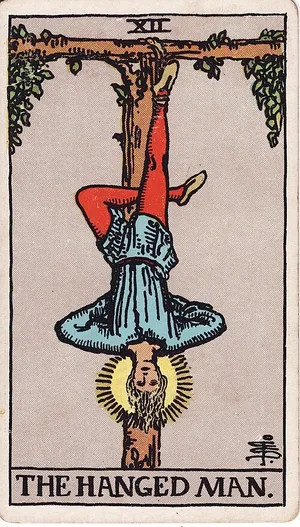

The Hanged Man is card XII (12) of the 22 Major Arcana in the Rider–Waite–Smith tarot. It shows a young man hanging upside down by one foot from a T-shaped wooden frame, one leg bent behind the other, with a yellow halo round his head and a calm face. Upright, it is read as a pause, surrender or a change of perspective; reversed, as being stuck, waiting without purpose, or resisting a pause that is needed.
Key facts
- Number and place: XII, between Justice (XI) and Death (XIII).
- Other names: none in Waite; he and the printed card use THE HANGED MAN.
- Upright in one line: suspension, letting go, seeing from another angle.
- Reversed in one line: stalling, pointless sacrifice, refusing to stop.
- Waite’s own key words (1910): wisdom, circumspection, discernment, trials, sacrifice, intuition, divination, prophecy.
What the picture shows
The background is a plain warm grey. Across the top runs a rough wooden beam, and an upright post of the same wood rises behind the figure, so that the frame makes a capital T. Sprigs of green leaves grow from both ends of the beam. Waite insists on this detail: “the tree of sacrifice is living wood, with leaves thereon”.
The man hangs head down from the beam by one foot. His other leg is bent at the knee and crossed behind the straight one, which gives the shape Waite calls a fylfot cross; many readers today simply see a figure 4. He wears red hose, a blue belted tunic that falls down over his chest because he is upside down, and pale yellow shoes. His arms bend at the elbows, with his hands hidden behind his back. His fair hair hangs down towards the ground.
Round his head is a yellow halo with fine rays. His face is quiet, with no sign of strain or pain, which matches Waite’s note that it “expresses deep entrancement, not suffering”. Smith’s monogram is in the lower right corner.
Waite’s meanings in 1910
In Part III of The Pictorial Key to the Tarot, Waite lists the Hanged Man’s meanings as:
“Wisdom, circumspection, discernment, trials, sacrifice, intuition, divination, prophecy. Reversed: Selfishness, the crowd, body politic.”
In Part II, he names the shapes first: the gallows “forms a Tau cross”, the legs “a fylfot cross”, and there is “a nimbus about the head of the seeming martyr”. Then he makes three points about the picture: the wood is living, the face shows trance and not suffering, and “the figure, as a whole, suggests life in suspension, but life and not death”.
He is dismissive of earlier explanations. The card “has been called falsely a card of martyrdom, a card of prudence, a card of the Great Work, a card of duty”, and he says one may “exhaust all published interpretations and find only vanity”. His own view is that it “expresses the relation, in one of its aspects, between the Divine and the Universe”. Anyone who sees their “higher nature” in the symbol, he writes, “will receive intimations concerning a great awakening that is possible”, and will know that “after the sacred Mystery of Death there is a glorious Mystery of Resurrection”. Even so, he says plainly that “all the significance is veiled”.
How the card is usually read today
One common modern reading of the Hanged Man is a willing pause: stopping, letting go of the urge to push, and seeing the situation upside down until something new comes into view. On this reading the stillness is chosen, not imposed. It is offered here as a prompt for reflection, not a statement about what will come.
Upright. Readers often speak of waiting with patience, giving something up for a larger aim, or a shift in viewpoint that changes what a problem looks like. Some point to the calm face and the halo: the position looks uncomfortable, yet the man seems at peace in it.
Reversed. Waite’s reversed words, “Selfishness, the crowd, body politic”, are short and hard to interpret. Many later readings describe the pause gone wrong: being stuck without learning anything, a sacrifice that serves no one, or the restlessness of refusing to stop when stopping would help.
Questions the card can bring up:
- What would I notice if I looked at this situation from the opposite side?
- Is there something I am holding on to that I could let go of for now?
- Am I waiting because waiting helps, or because I am afraid to choose?
Upright and reversed at a glance
| Upright | Reversed | |
|---|---|---|
| Waite, 1910 | Wisdom, circumspection, discernment, trials, sacrifice, intuition, divination, prophecy | Selfishness, the crowd, body politic |
| Common reading today | A chosen pause; surrender; a new perspective | Being stuck; pointless sacrifice; refusing to pause |
| A question to ask | What changes if I stop pushing? | What is this waiting really for? |
The Hanged Man in a spread
Read the card through the position it occupies.
- Three cards (Past, Present, Future). In the Past, it can recall a period of waiting or giving something up that changed how you saw things. In the Present, it asks whether a pause would serve you better than another push. In the Future position, readers usually take it as an invitation to leave room for a new view before acting, not as a forecast of delay.
- Celtic cross. In the Root position, it can point to an old sacrifice the situation still rests on. In the Hopes position, it may name a wish to step back; next to Death, many readers read the pair as a pause that leads into a real ending and a new start.
The positions of both spreads and the names of all 78 cards are in the tarot glossary; where the deck and its pictures come from is in the 1909 Rider–Waite–Smith tarot.
Cards often read next to the Hanged Man
- Justice (XI), the card before it: a judgement made; the Hanged Man suspends judgement to look again.
- Death (XIII), the card after it: Waite’s Part II entry for the Hanged Man ends on “the sacred Mystery of Death” and “a glorious Mystery of Resurrection”, and readers often carry that theme into the next card.
- The Hermit (IX): another withdrawal, but standing upright on a peak, where the Hanged Man is held upside down.
- The Fool (0): a figure who also lets go of control, though by stepping out rather than hanging still.
In HeyFate, each card you draw is turned upright or reversed at random with even odds, and an AI model writes the reading. This page is the reference behind the card, not a reading of your own question.
Sources
- A. E. Waite, The Pictorial Key to the Tarot, Part II, “XII. The Hanged Man” (Wikisource, from the 1922 reprint)
- A. E. Waite, The Pictorial Key to the Tarot, Part III, §3, the divinatory meanings of the Greater Arcana (Wikisource, from the 1922 reprint)
- Wikimedia Commons: RWS Tarot 12 Hanged Man.jpg (Pam-A scan, public domain)
AI-generated content, for reference only; not medical, legal, financial or psychological advice. These methods come from cultural traditions, and HeyFate offers them for cultural interest, entertainment and self-reflection.