Queen of Swords Tarot Card Meaning: Upright, Reversed and Symbolism
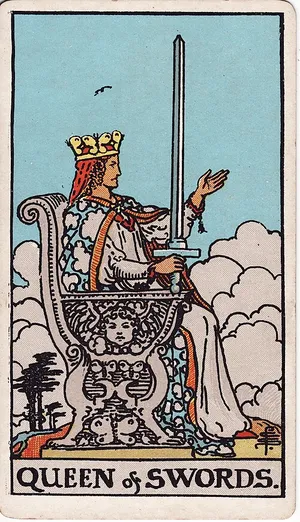

The Queen of Swords is one of the four court cards in the suit of Swords, one of the four suits of 14 cards that make up the 56 Minor Arcana of the Rider–Waite–Smith tarot, drawn by Pamela Colman Smith and published in London in 1909. It shows a crowned queen seated in profile on a stone throne, holding a sword straight up in her right hand and raising her left hand open in front of her. Upright, it is usually read as clear judgement, honesty and independence, often shaped by experience of loss; reversed, as that clarity turning cold, bitter or harsh.
Key facts
- Suit: Swords, a suit usually linked with thought, words, conflict and hard decisions. The pairing commonly given today is Swords with Air; other systems differ (Papus has Swords with Earth); see the 1909 Rider–Waite–Smith tarot.
- Rank and place: a court card, the Queen; the title QUEEN of SWORDS is printed at the bottom. It follows the Knight of Swords and comes before the King.
- Upright in one line: clear sight, plain speaking, fairness, standing on one’s own.
- Reversed in one line: coldness, harsh criticism, holding a grudge, cutting others off.
- Waite’s own key words (1910, selected): widowhood, sadness, absence, mourning, separation; “familiarity with sorrow”.
What the picture shows
The queen sits facing the right-hand side of the card, so we see her in profile. She wears a gold crown decorated with what look like small butterflies, and a red-orange veil falls from under it down her back over curling hair. Her gown is pale grey; over it hangs a cloak printed with white clouds on blue, edged with red-orange bands. Her right hand holds a long sword straight up, its blade running towards the top of the card, and the hilt rests on the arm of the throne. Her left arm is lifted and stretched forward, the hand open, palm turned upward. A red band circles that wrist, with a tassel, dark in this scan, hanging from it.
The throne is grey stone with a tall scrolled back. Carved on its visible side, just below the seat, is a child’s face with wings around it; below that the carving continues with shapes that look like butterfly wings. Behind her the sky is clear pale blue, with a single bird high up on the left. Clouds are banked low on the right, below the level of her raised hand, and dark trees stand at the lower left. The title is printed at the bottom and Smith’s monogram is at the lower right.
Waite’s note follows the picture closely: “Her right hand raises the weapon vertically and the hilt rests on an arm of her royal chair; the left hand is extended, the arm raised; her countenance is severe but chastened; it suggests familiarity with sorrow.” He then says what she is not: “It does not represent mercy, and, her sword notwithstanding, she is scarcely a symbol of power.” Waite does not assign meanings to the butterflies, clouds or open hand in this entry.
Waite’s meanings in 1910
In Part III, §2, where Waite gathers the meanings of the Minor Arcana “from all sources”, he gives for the Queen of Swords:
“Widowhood, female sadness and embarrassment, absence, sterility, mourning, privation, separation. Reversed: Malice, bigotry, artifice, prudery, bale, deceit.”
The upright list is almost all loss, which matches the “familiarity with sorrow” of his picture note. Embarrassment in 1910 could also mean being in difficulties, and bale is an old word for harm or woe. These words describe the stock character of a grieving woman in older fortune-telling; they are not statements about anyone’s marriage, family or body.
In §4, “Some Additional Meanings of the Lesser Arcana”, the further set of meanings Waite lists is shorter still: “A widow. Reversed: A bad woman, with ill-will towards the Querent.” Formulas like this come from period cartomancy, which sorted court cards into types of person, often by sex and marital status. They are kept here as history.
How the card is usually read today
One common modern reading takes the Queen of Swords as a person who sees clearly because she has been through something hard, and who says what she sees. In this reading the sorrow Waite describes becomes the source of her clarity, rather than the whole of her. Court cards are often read as a person in the situation or as a side of yourself. Use it for reflection, not as a forecast.
Upright. Readers often connect it with honesty, independence, sharp perception, setting boundaries, or giving fair but unsentimental advice. The upright sword is read as judgement held steady; the open hand, as a willingness to listen before deciding.
Reversed. Waite’s reversed list, from “Malice” to “deceit”, is a list of ill will and pretence. Later readings take the reversed Queen as clarity gone cold: harsh criticism, bitterness, using words to wound, or shutting people out after being hurt.
Questions to sit with:
- What do I see clearly here that I have not yet said?
- Is my judgement in this matter fair, or is it guarding an old hurt?
- Where could I be honest and kind at the same time?
Upright and reversed at a glance
| Upright | Reversed | |
|---|---|---|
| Waite, 1910 | Widowhood, sadness, absence, mourning, privation, separation | Malice, bigotry, artifice, prudery, bale, deceit |
| Common reading today | Clear judgement, honesty, independence | Coldness, harsh criticism, bitterness |
| A question to ask | What do I see clearly, and how will I say it? | Is my sharpness protecting me, or hurting others? |
The Queen of Swords in a spread
As a court card she can stand for a person, an attitude, or a way of dealing with the matter.
- Three cards (Past, Present, Future). In the Past position, it can invite a look at a hard experience that taught you to see clearly. In the Present, it asks where honest judgement is needed now. In the Future position, readers usually take it as a prompt to think about where you want to speak plainly, not as a fixed event.
- Celtic cross. In the Self position, it may ask whether you are meeting the matter with a clear head or a guarded heart. In the Environment position, it can stand for a frank, perceptive person whose view is worth hearing. In the Challenge position, it may point to coldness or criticism that makes things harder.
The positions of both spreads and the names of all 78 cards are in the tarot glossary; where the deck and its pictures come from is in the 1909 Rider–Waite–Smith tarot.
Cards often read next to the Queen of Swords
- Knight of Swords, the court card before her: the sword at full gallop; in her hand it stands still.
- King of Swords, the next court card: another seated figure with an upright sword, read as judgement with authority behind it.
- Queen of Cups: Waite’s “Beautiful, fair, dreamy—as one who sees visions in a cup”; feeling and imagination set against clear thought.
- Queen of Pentacles: in Waite’s entry she “contemplates her symbol and may see worlds therein”; practical care set against the Queen of Swords’ frankness.
In HeyFate, each card you draw is turned upright or reversed at random with even odds, and an AI model writes the reading. This page is the reference behind the card, not a reading of your own question.
Sources
- A. E. Waite, The Pictorial Key to the Tarot, Part III, §2, “The Suit of Swords: Queen”, also citing the Queen of Cups and Queen of Pentacles (Wikisource, from the 1922 reprint)
- A. E. Waite, The Pictorial Key to the Tarot, Part III, §4, “Some Additional Meanings of the Lesser Arcana” (Wikisource, from the 1922 reprint)
- Wikimedia Commons: Swords13.jpg (Pam-A scan, public domain)
AI-generated content, for reference only; not medical, legal, financial or psychological advice. These methods come from cultural traditions, and HeyFate offers them for cultural interest, entertainment and self-reflection.