Queen of Pentacles Tarot Card Meaning: Upright, Reversed and Symbolism
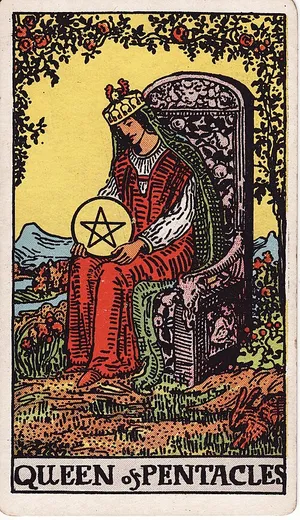

The Queen of Pentacles is one of the 56 Minor Arcana in the Rider–Waite–Smith tarot: a court card, the Queen in the suit of Pentacles, drawn by Pamela Colman Smith and published in London in 1909. It shows a crowned woman on a carved stone throne in a garden, holding a pentacle in her lap and looking down at it, with roses overhead and a rabbit at her feet. Upright, it is usually read as practical care, generosity and a steady, well-kept life; reversed, as care stretched too thin, or security that feels uncertain.
Key facts
- Suit: Pentacles, the suit usually connected with work, money, the body, home and the material side of life. Today’s common pairing gives it earth; schools differ on the suits and elements, as the 1909 Rider–Waite–Smith tarot article shows.
- Rank: a court card, the Queen, third of the four court ranks (Page, Knight, Queen, King). It comes between the Knight and the King of Pentacles.
- Suit name: the suit was coins in many older decks; in his entry for the King of Pentacles, Waite notes that “In many old Tarot packs this suit stood for current coin, money, deniers”.
- Upright in one line: nurturing, resourcefulness, generosity, a home that is looked after.
- Reversed in one line: overextending yourself, worry about security, care that smothers or runs dry.
- Waite’s own key words (1910): “Opulence, generosity, magnificence, security, liberty”.
What the picture shows
The sky is a flat bright yellow, and the title QUEEN of PENTACLES is printed at the bottom. Across the top of the card, and down its right side, runs a bower of dark rose stems with red roses. Under it, the queen sits on a tall throne of grey-pink stone, turned a little to our left. The throne is covered with carved motifs, though not every detail is clear in this scan.
She wears a gold crown topped with a small red ornament, and from it a long green veil falls behind her shoulders, down the side of the throne and onto the ground. Her gown is red, with white sleeves and a white collar. She holds a large pentacle on her lap with both hands, her head bowed towards it. Waite’s note dwells on her face and her gaze: “she contemplates her symbol and may see worlds therein.”
To the left, beyond her, is a landscape of green fields, a stretch of blue water, trees in orange and red, and a blue mountain on the horizon. Red flowers grow at the edges of the picture. The ground in front of the throne is bare brown earth with tufts of grass, and in the lower right corner a brown rabbit crouches. Waite’s entry does not discuss the rabbit.
Waite’s meanings in 1910
Waite’s entry for the card in Part III, §2 of The Pictorial Key to the Tarot begins with a portrait: “The face suggests that of a dark woman, whose qualities might be summed up in the idea of greatness of soul; she has also the serious cast of intelligence”. This entry does not spell out what “dark” refers to; in §7, as a guide to choosing a card to stand for a person, Waite refers the Pentacles court cards to “persons with very dark brown or black hair, dark eyes and sallow or swarthy complexions”. His divinatory meanings follow:
“Opulence, generosity, magnificence, security, liberty. Reversed: Evil, suspicion, suspense, fear, mistrust.”
The upright list moves from having to giving: opulence, then generosity and “magnificence” in its older sense of grand, open-handed spending, then security and liberty. Liberty is the interesting last word: in this reading what the Queen holds gives her freedom, not only comfort. The reversed list is almost all about the mind: suspicion, suspense, fear and mistrust are states of uncertainty rather than events.
Part III, §4, “Some Additional Meanings of the Lesser Arcana”, adds a further list:
“Dark woman; presents from a rich relative; rich and happy marriage for a young man. Reversed: An illness.”
These are period fortune-telling formulas, kept here as history. They show how cartomancers of the time turned a card into a type of person, a gift or a marriage, and the reversed line is one of their stock formulas. None of it is a statement about the health, family or finances of anyone reading this page.
How the card is usually read today
One common modern reading takes the Queen of Pentacles as the card of practical care: someone who looks after people, places and resources with a steady hand, and makes a home or a workplace feel looked after. Read it as a prompt for reflection, not as a promise about money or anyone’s circumstances. Waite’s list for her opens with “Opulence”, yet the care in this reading is not measured in money, which fits his remark in the King of Pentacles entry that the suit’s cards “do not happen to deal especially with questions of money”.
Upright. Readers often connect it with generosity, resourcefulness, hospitality, common sense, and balancing work with the life around it. Some link the garden and the rabbit to tending and growth, and the bowed head to the attention she gives to what is in her hands.
Reversed. Waite’s reversed list is about fear and mistrust. Later readings often take the reversed Queen as care out of balance: giving to everyone but yourself, worrying over security, holding on too tightly, or letting the work of keeping things running crowd out the life it was meant to support.
Questions people often take from the card:
- What am I looking after, and who is looking after me?
- Where could a practical, unshowy kind of care make a difference?
- Is my sense of security coming from what I have, or from trust?
Upright and reversed at a glance
| Upright | Reversed | |
|---|---|---|
| Waite, 1910 | Opulence, generosity, magnificence, security, liberty | Evil, suspicion, suspense, fear, mistrust |
| Common reading today | Practical care, resourcefulness, generosity | Care stretched too thin; worry over security |
| A question to ask | What am I tending well? | What do I need to receive, not just give? |
The Queen of Pentacles in a spread
- Three cards (Past, Present, Future). In the Past position, it can point to someone’s steady care, or your own, that still supports the situation. In the Present, it asks how well you are tending your time, home and resources. In the Future position, readers usually take it as an invitation to think about what kind of care you want to give and receive, not as a fixed event.
- Celtic cross. In the Self position, the Queen can invite reflection on how you look after others and yourself. In the Environment position, it may point to a person or household around you who provides that kind of care. In the Challenge position, it can point to the strain of looking after too much at once.
The positions of both spreads and the names of all 78 cards are in the tarot glossary; where the deck and its pictures come from is in the 1909 Rider–Waite–Smith tarot.
Cards often read next to the Queen of Pentacles
- Knight of Pentacles, the court card before it: a knight still on a heavy horse, read as slow, steady effort.
- King of Pentacles, the court card after it: a king on a throne of bulls’ heads among vines, read as established, practical authority.
- Queen of Cups: the same rank in Cups, whom Waite describes as one “who sees visions in a cup”; read as emotional care, where this Queen’s is practical.
- Queen of Swords: the same rank in Swords, a queen holding her sword upright; read as clear judgement, a useful contrast to the Queen of Pentacles’ warmth.
In HeyFate, each card you draw is turned upright or reversed at random with even odds, and an AI model writes the reading. This page is the reference behind the card, not a reading of your own question.
Sources
- A. E. Waite, The Pictorial Key to the Tarot, Part III, §2, “The Suit of Pentacles: Queen”, also citing “The Suit of Pentacles: King” and “The Suit of Cups: Queen” (Wikisource, from the 1922 reprint)
- A. E. Waite, The Pictorial Key to the Tarot, Part III, §4, “Some Additional Meanings of the Lesser Arcana” (Wikisource, from the 1922 reprint)
- A. E. Waite, The Pictorial Key to the Tarot, Part III, §7, “An Ancient Celtic Method of Divination” (Wikisource, from the 1922 reprint)
- Wikimedia Commons: Pents13.jpg (Pam-A scan, public domain)
AI-generated content, for reference only; not medical, legal, financial or psychological advice. These methods come from cultural traditions, and HeyFate offers them for cultural interest, entertainment and self-reflection.