King of Pentacles Tarot Card Meaning: Upright, Reversed and Symbolism
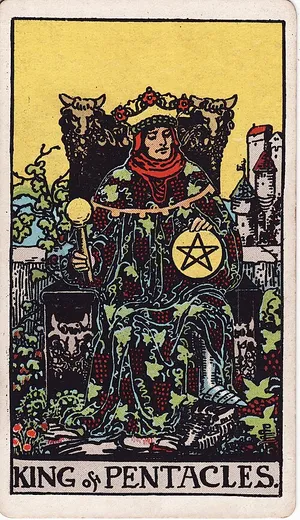

The King of Pentacles is one of the 56 Minor Arcana in the Rider–Waite–Smith tarot: a court card, the King in the suit of Pentacles, drawn by Pamela Colman Smith and published in London in 1909. It shows a crowned king seated on a dark throne carved with bulls’ heads, his robe covered in grapes and vine leaves, a sceptre in one hand and a pentacle under the other, with a castle behind him. Upright, it is usually read as steady, practical authority and resources managed well; reversed, as that steadiness turning rigid, controlling or careless.
Key facts
- Suit: Pentacles, the suit usually linked with work, money, the body and the material side of life. Today’s common pairing gives it earth; other writers pair the suits differently, and Waite gives no table of his own (see the 1909 Rider–Waite–Smith tarot).
- Rank: a court card, the King, the last of the four court ranks (Page, Knight, Queen, King). It follows the Queen of Pentacles.
- Suit name: the suit was coins in many older decks, as Waite notes in this card’s own entry: “In many old Tarot packs this suit stood for current coin, money, deniers.”
- Upright in one line: practical leadership, reliability, a well-run household or business.
- Reversed in one line: stubbornness, materialism, control, resources handled badly.
- Waite’s own key words (1910): “Valour, realizing intelligence, business and normal intellectual aptitude”; “success in these paths”.
What the picture shows
The sky is a flat bright yellow, and the title KING of PENTACLES runs along the bottom. The king sits facing us on a high, dark throne. Carved bulls’ heads, with short curved horns, top its two back corners, and more bulls’ heads appear on the blocks at the front of the arms. Waite asks for exactly this: “The bull’s head should be noted as a recurrent symbol on the throne.”
His long robe is almost black, covered with clusters of dark red grapes and pale green vine leaves joined by thin blue tendrils, so that he seems to merge with the vines growing around him. A red hood frames his face. His gold crown is decorated with red flowers and worn over a dark cap; in his entry for the King of Wands, Waite says that King wears, “like his three correspondences in the remaining suits, what is called a cap of maintenance beneath his crown”. His eyes are lowered. His right hand holds a sceptre topped by a golden orb, and his left rests on a large pentacle propped on his knee. Below the hem of the robe, on our right, his foot shows in plate armour.
Behind him runs a low wall. On the left, beyond it, vines climb and spread; on the right rises a castle with several towers and red-roofed turrets. Red flowers grow in the lower left corner, more vine leaves at the lower right, and Smith’s monogram is at the lower right edge.
Waite’s meanings in 1910
This is the card where Waite writes about the whole suit. In his entry in Part III, §2 of The Pictorial Key to the Tarot, he first gives a short portrait, “the face is rather dark, suggesting also courage, but somewhat lethargic in tendency”. The entry does not spell out what “dark” refers to; in §7, as a guide to choosing a card to stand for a person, Waite refers the Pentacles court cards to “persons with very dark brown or black hair, dark eyes and sallow or swarthy complexions”. Then he turns to the pentacle itself: “The sign of this suit is represented throughout as engraved or blazoned with the pentagram, typifying the correspondence of the four elements in human nature and that by which they may be governed.” And he addresses the old coins directly: “I have not invented the substitution of pentacles and I have no special cause to sustain in respect of the alternative. But the consensus of divinatory meanings is on the side of some change, because the cards do not happen to deal especially with questions of money.”
His divinatory meanings follow:
“Valour, realizing intelligence, business and normal intellectual aptitude, sometimes mathematical gifts and attainments of this kind; success in these paths. Reversed: Vice, weakness, ugliness, perversity, corruption, peril.”
“Realizing intelligence” can be read as practical intelligence, though Waite does not define the phrase. The list is practical rather than grand, with business, “normal intellectual aptitude” and even “mathematical gifts”. The reversed list combines moral judgements with weakness, ugliness and, at the end, “peril”.
Part III, §4, “Some Additional Meanings of the Lesser Arcana”, adds a further list:
“A rather dark man, a merchant, master, professor. Reversed: An old and vicious man.”
These are period fortune-telling formulas, kept here as history. Like the other court cards in this suit, the King becomes a type of person who might enter the querent’s life, here sorted by trade. Nothing in it is a statement about the reader of this page.
How the card is usually read today
One common modern reading takes the King of Pentacles as the suit’s settled authority: someone who has built something that works and looks after it with patience. In that reading the vines that cover his robe can prompt thoughts about long-term tending and care. Treat it as a prompt for reflection rather than a promise about money or success; Waite’s own remark that the cards “do not happen to deal especially with questions of money” is a good reminder here.
Upright. Readers often connect it with practical leadership, reliability, generosity backed by means, good stewardship, business sense and the calm of someone who knows their work.
Reversed. Waite’s reversed list is about vice and corruption. Later readings tend to frame it as strengths gone wrong: stubbornness, an attachment to status or possessions, control over others through resources, overwork that leaves nothing for anything else, or decisions made carelessly by someone who used to be careful.
Questions people often take from the card:
- What have I built that I now need to look after rather than enlarge?
- How do I use the resources and influence I have, and for whom?
- Where has steadiness become rigidity?
Upright and reversed at a glance
| Upright | Reversed | |
|---|---|---|
| Waite, 1910 | Valour, realizing intelligence, business and intellectual aptitude; success in these paths | Vice, weakness, ugliness, perversity, corruption, peril |
| Common reading today | Practical authority, stewardship, reliability | Stubbornness, materialism, control through resources |
| A question to ask | What am I responsible for keeping well? | Where is holding on costing me more than it gives? |
The King of Pentacles in a spread
- Three cards (Past, Present, Future). In the Past position, it can point to a person, a role or a period of steady responsibility that shaped the situation. In the Present, it asks how you are using what you have built up. In the Future position, readers usually take it as an invitation to think about the kind of stability you want to create and maintain, not as a forecast of success.
- Celtic cross. In the Crown position, the King can invite reflection on the long-term aim behind the question. In the Environment position, it may point to an established person or institution whose influence is felt. In the Outcome position, many readers read it with the cards around it as a question about what you are willing to take responsibility for.
The positions of both spreads and the names of all 78 cards are in the tarot glossary; where the deck and its pictures come from is in the 1909 Rider–Waite–Smith tarot.
Cards often read next to the King of Pentacles
- Queen of Pentacles, the court card before it: a queen gazing at the pentacle in her lap, read as practical care beside the King’s practical rule.
- King of Cups: the same rank in Cups, a king whose throne, in Waite’s words, “is set upon the sea”; read as emotional steadiness.
- King of Wands: the same rank in Wands, the entry in which Waite describes the kings’ “cap of maintenance”; read as vision and drive.
- King of Swords: the same rank in Swords, a king who, Waite writes, “sits in judgment”; read as authority through reason.
In HeyFate, each card you draw is turned upright or reversed at random with even odds, and an AI model writes the reading. This page is the reference behind the card, not a reading of your own question.
Sources
- A. E. Waite, The Pictorial Key to the Tarot, Part III, §2, “The Suit of Pentacles: King”, also citing “The Suit of Wands: King”, “The Suit of Cups: King” and “The Suit of Swords: King” (Wikisource, from the 1922 reprint)
- A. E. Waite, The Pictorial Key to the Tarot, Part III, §4, “Some Additional Meanings of the Lesser Arcana” (Wikisource, from the 1922 reprint)
- A. E. Waite, The Pictorial Key to the Tarot, Part III, §7, “An Ancient Celtic Method of Divination” (Wikisource, from the 1922 reprint)
- Wikimedia Commons: Pents14.jpg (Pam-A scan, public domain)
AI-generated content, for reference only; not medical, legal, financial or psychological advice. These methods come from cultural traditions, and HeyFate offers them for cultural interest, entertainment and self-reflection.