Knight of Pentacles Tarot Card Meaning: Upright, Reversed and Symbolism
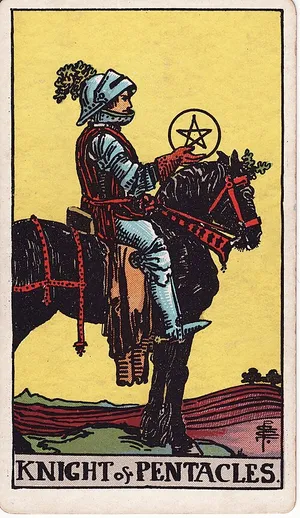

The Knight of Pentacles is one of the 56 Minor Arcana in the Rider–Waite–Smith tarot: a court card, the Knight in the suit of Pentacles, drawn by Pamela Colman Smith and published in London in 1909. It shows a knight in armour sitting on a heavy black horse that stands still above ploughed fields, a pentacle held out in his gloved hand. Upright, it is usually read as patience, reliability and steady, methodical work; reversed, as steadiness that has set into inertia.
Key facts
- Suit: Pentacles, the suit usually tied to work, money, the body and practical matters. Today’s common pairing links it with earth, though schools pair the suits differently; see the tarot glossary and the 1909 Rider–Waite–Smith tarot.
- Rank: a court card, the Knight, second of the four court ranks (Page, Knight, Queen, King). It comes between the Page and the Queen of Pentacles.
- Suit name: the suit was coins in many older decks; in his entry for the King of Pentacles, Waite notes that “In many old Tarot packs this suit stood for current coin, money, deniers”.
- Upright in one line: diligence, dependability, slow and sure progress.
- Reversed in one line: stagnation, idleness, routine without purpose.
- Waite’s own key words (1910): “Utility, serviceableness, interest, responsibility, rectitude—all on the normal and external plane”.
What the picture shows
The sky is a flat bright yellow, and the title KNIGHT of PENTACLES runs along the bottom. The knight sits upright in the saddle, facing right. He wears plate armour, drawn in pale blue-grey, under a red surcoat marked with dark stripes, and his helmet has its visor raised to show his face; a sprig of green leaves rises from its crest. In one hand, covered by a red mail glove, he holds a pentacle out in front of him at about shoulder height.
The horse is black, heavily built, and stands with its forelegs planted on a small green rise. Its bridle and the band across its chest are red, the band patterned in black and finished with tassels, and another sprig of leaves sits on its head. A red strap with dots hangs from the saddle behind the knight. Waite’s note gives the whole character of the card in the horse: “He rides a slow, enduring, heavy horse, to which his own aspect corresponds.”
Waite adds, “He exhibits his symbol, but does not look therein.” In the scan the knight’s eyes seem to look straight ahead, past the top of the disc rather than down into it, which fits the note. Behind him a wide field of red-brown furrows rolls back towards the horizon, with a green ridge on the left and a small clump of trees on the right. Smith’s monogram is at the lower right.
Waite’s meanings in 1910
In Part III, §2 of The Pictorial Key to the Tarot, Waite gives these divinatory meanings for the card:
“Utility, serviceableness, interest, responsibility, rectitude—all on the normal and external plane. Reversed: inertia, idleness, repose of that kind, stagnation; also placidity, discouragement, carelessness.”
Two things stand out. The upright list is about being useful and upright: “serviceableness” is being of service, “rectitude” is moral straightness. And Waite fences it in with “all on the normal and external plane”: these are virtues of ordinary, outward life, not spiritual qualities. The reversed list follows the same slow horse in the other direction. Where the upright Knight’s steadiness serves, the reversed one stops moving at all: “inertia”, “repose of that kind”, “stagnation”.
Part III, §4, “Some Additional Meanings of the Lesser Arcana”, adds a further list:
“An useful man; useful discoveries. Reversed: A brave man out of employment.”
These are period fortune-telling formulas, kept here as history. The word “useful” appears twice, matching the “Utility” that opens §2; the reversed line pictures a brave man with no work to put his courage to. Neither says anything about the reader of this page.
How the card is usually read today
One common modern reading takes the Knight of Pentacles as the card of steady effort: the person who keeps going at an even pace, finishes what they start and can be relied on. In that reading the stillness of the horse is not laziness but patience. Use it as a prompt for reflection rather than a sign of what will happen.
Upright. Readers often connect it with routine that works, responsibility, careful planning, keeping promises, and slow progress that holds. Some contrast it with the other three Knights, who are usually read as faster and more restless.
Reversed. Here Waite’s list and today’s readings are close. Later readings speak of being stuck in a rut, boredom, stubbornness, caution that has turned into never moving, or the opposite: carelessness about work that used to be done well. Some read it as perfectionism that keeps a task from being finished.
Questions people often take from the card:
- Where is patience serving me, and where has it become waiting?
- What would steady, unglamorous effort look like this week?
- Is my routine still carrying me somewhere, or only keeping me in place?
Upright and reversed at a glance
| Upright | Reversed | |
|---|---|---|
| Waite, 1910 | Utility, serviceableness, responsibility, rectitude, “on the normal and external plane” | Inertia, idleness, stagnation; placidity, discouragement, carelessness |
| Common reading today | Diligence, reliability, slow and sure progress | Stuck in a rut, stubbornness, routine without purpose |
| A question to ask | What can I keep working at, steadily? | Where have I stopped moving? |
The Knight of Pentacles in a spread
- Three cards (Past, Present, Future). In the Past position, it can point to a period of patient, reliable work that you are still building on. In the Present, it asks whether your pace suits what the situation needs. In the Future position, readers usually take it as an invitation to commit to steady effort, not as a promise that it will pay off.
- Celtic cross. In the Self position, the Knight can invite reflection on how dependable you are being, and for whom. In the Challenge position, it may point to slowness, or a routine that has outlived its purpose. In the Outcome position, many readers read it with the cards around it as a question about what you are prepared to keep doing over time.
The positions of both spreads and the names of all 78 cards are in the tarot glossary; where the deck and its pictures come from is in the 1909 Rider–Waite–Smith tarot.
Cards often read next to the Knight of Pentacles
- Page of Pentacles, the court card before it: the youth studying a pentacle on foot. The Knight carries the same symbol into action, slowly.
- Queen of Pentacles, the court card after it: a seated queen with a pentacle in her lap, read as care and resourcefulness.
- Knight of Wands: the same rank in Wands, a rider on a rearing horse; read as eagerness and haste, the opposite pace.
- Knight of Swords: the same rank in Swords, a knight charging at full speed; read as fast, forceful action, where this Knight stays put.
In HeyFate, each card you draw is turned upright or reversed at random with even odds, and an AI model writes the reading. This page is the reference behind the card, not a reading of your own question.
Sources
- A. E. Waite, The Pictorial Key to the Tarot, Part III, §2, “The Suit of Pentacles: Knight”, also citing “The Suit of Pentacles: King” (Wikisource, from the 1922 reprint)
- A. E. Waite, The Pictorial Key to the Tarot, Part III, §4, “Some Additional Meanings of the Lesser Arcana” (Wikisource, from the 1922 reprint)
- Wikimedia Commons: Pents12.jpg (Pam-A scan, public domain)
AI-generated content, for reference only; not medical, legal, financial or psychological advice. These methods come from cultural traditions, and HeyFate offers them for cultural interest, entertainment and self-reflection.