Knight of Wands Tarot Card Meaning: Upright, Reversed and Symbolism
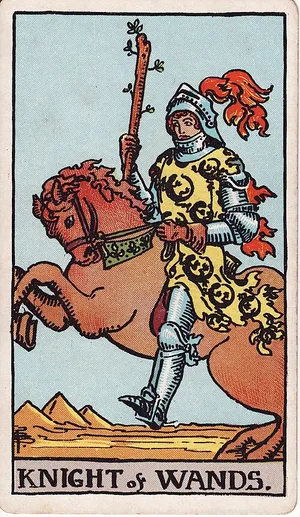

The Knight of Wands is one of the four court cards in the suit of Wands, one of the four suits that make up the 56 Minor Arcana in the Rider–Waite–Smith tarot, drawn by Pamela Colman Smith and published in London in 1909. It shows a knight in armour on a rearing horse, a short leafy wand raised in one hand, riding past three pyramids in a desert. Upright, it is usually read as energy, boldness and a sudden move or journey; reversed, as that drive turned reckless, broken off or frustrated.
Key facts
- Suit: Wands. The pairing commonly given today is Fire, but writers differ and his entries for the suit do not name one; see the 1909 Rider–Waite–Smith tarot. In his entry for the Queen of Wands, Waite calls it “a suit of life and animation”; today it is usually linked with energy, drive, work and plans.
- Rank: a court card, the second of the four (Page, Knight, Queen, King).
- Upright in one line: action, adventure, haste, a departure or change of scene.
- Reversed in one line: impulsiveness, interruption, plans that break apart, friction.
- Waite’s own key words (1910, shortened): “Departure, absence, flight, emigration”; “Change of residence”; reversed, “Rupture, division, interruption, discord”.
What the picture shows
The horse fills the left half of the card. It rears up on its hind legs with both forelegs lifted, its head turned to the left, its orange-brown body drawn with a mane of red, curling strands that look like flames. A green band with a leaf pattern crosses its chest, and a red bridle runs round its head.
The knight sits upright on its back in silver plate armour. His helmet has the visor raised, so his face is visible, and a long red-orange plume streams from it like a flame; more red, flame-shaped ribbons flutter at his elbow. Over his armour he wears a yellow tunic patterned with black, curling lizard-like shapes, some bent into rings. Similar lizard-like shapes appear on the Page and the King of Wands. In his right hand he holds up a short staff with green leaves sprouting from it; his left, in a brown gauntlet, holds the reins. His pointed metal shoe reaches down towards the sand.
At the lower left, three pyramids rise from a strip of yellow desert, and Smith’s monogram is beside them. The sky is pale blue, and the title KNIGHT of WANDS runs along the bottom.
Waite’s note: “He is shewn as if upon a journey, armed with a short wand, and although mailed is not on a warlike errand. He is passing mounds or pyramids. The motion of the horse is a key to the character of its rider, and suggests the precipitate mood, or things connected therewith.” In his wording, “mailed” means armoured and “precipitate” means hasty, rushing ahead. So Waite tells us to read the rider through the horse: the rearing animal is the knight’s own temper.
Waite’s meanings in 1910
In Part III, §2 of The Pictorial Key to the Tarot, Waite gives the divinatory meanings:
“Departure, absence, flight, emigration. A dark young man, friendly. Change of residence. Reversed: Rupture, division, interruption, discord.”
Almost every upright word is about leaving: departure, absence, flight, emigration, a change of residence. That fits the picture of a man “as if upon a journey”. The reversed words are about breaks between people or plans. “A dark young man” reflects the period practice of reading a court card as a person by hair and complexion, though in §7, describing the Celtic method, Waite assigns the Wands court cards to “very fair people, with yellow or auburn hair, fair complexion and blue eyes”. He does not explain the difference.
Section 4, “Some Additional Meanings of the Lesser Arcana”, is a further set of meanings Waite lists for each card; after the list he notes that they “are very often in disagreement with those previously given”. For the Knight:
“Knight.—A bad card; according to some readings, alienation. Reversed: For a woman, marriage, but probably frustrated.”
These §4 lines are period fortune-telling formulas, kept here as history, not as anything about the reader. The line about marriage shows how much of period card-reading served questions about courtship, and how a single card was given different meanings for men and women.
How the card is usually read today
One common modern reading treats the Knight of Wands as energy in motion: the Page’s idea now has a horse under it and is charging ahead. In that reading the card is about courage and appetite for adventure, and also about the risk that comes with speed. Use it to reflect on your own pace and plans, not as a forecast of a journey.
Upright. Common readings are bold action, travel or a move, starting something with confidence, passion for a cause, or a charismatic, restless energy. Following Waite’s hint, one can look at the horse: it is rearing, not galloping in a straight line, so the energy is strong but not yet steady.
Reversed. Waite gives “Rupture, division, interruption, discord”. Later readings more often take the reversed Knight as recklessness: rushing in without a plan, losing interest halfway, delays that cause frustration, or a temper that flares. Some read it as a cue to rein in before committing.
Questions people often take from the card:
- What am I eager to charge into, and have I looked where I am going?
- Is this a journey I am choosing, or am I running from something?
- Where would a little patience make my energy go further?
Upright and reversed at a glance
| Upright | Reversed | |
|---|---|---|
| Waite, 1910 | Departure, absence, flight, emigration; change of residence | Rupture, division, interruption, discord |
| Common reading today | Bold action, adventure, a move or journey | Recklessness, interruption, frustration |
| A question to ask | Where is my energy taking me? | What needs steadying before I go on? |
The Knight of Wands in a spread
Each position gives the Knight a different question.
- Three cards (Past, Present, Future). In the Past position, it can invite a look at a bold move or a departure that still shapes things. In the Present, it asks where your energy is going and how fast. In the Future position, readers usually take it as a prompt to think about a change you may want to make, not as a fixed event.
- Celtic cross. In the Challenge position, it may point to haste or impatience getting in the way. In the Environment position, it can stand for a lively, restless influence around you. In the Outcome position, many readers look at the cards beside it to see whether the energy is being directed or simply spent.
The positions of both spreads and the names of all 78 cards are in the tarot glossary; where the deck and its pictures come from is in the 1909 Rider–Waite–Smith tarot.
Cards often read next to the Knight of Wands
- Page of Wands, the court card before it: a similar desert with pyramids, where a young man stands still, looking at his staff. Waite says the Page’s scene is “similar to the former”, meaning this one.
- Queen of Wands, the court card after it: seated and settled, with a sunflower and a black cat; the suit’s energy held still.
- Knight of Swords: another knight, sword raised, on a white horse at full gallop; the two can be compared as contrasting pictures of haste.
In HeyFate, each card you draw is turned upright or reversed at random with even odds, and an AI model writes the reading. This page is the reference behind the card, not a reading of your own question.
Sources
- A. E. Waite, The Pictorial Key to the Tarot, Part III, §2, “The Suit of Wands: Knight”, with the Queen of Wands entry on the suit (Wikisource, from the 1922 reprint)
- A. E. Waite, The Pictorial Key to the Tarot, Part III, §4, “Some Additional Meanings of the Lesser Arcana” (Wikisource, from the 1922 reprint)
- A. E. Waite, The Pictorial Key to the Tarot, Part III, §7, “An Ancient Celtic Method of Divination” (Wikisource, from the 1922 reprint)
- Wikimedia Commons: Wands12.jpg (Pam-A scan, public domain)
AI-generated content, for reference only; not medical, legal, financial or psychological advice. These methods come from cultural traditions, and HeyFate offers them for cultural interest, entertainment and self-reflection.