Nine of Cups Tarot Card Meaning: Upright, Reversed and Symbolism
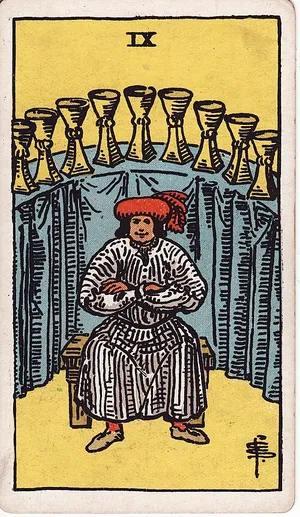

The Nine of Cups is one of the 56 Minor Arcana in the Rider–Waite–Smith tarot: the numbered card nine in the suit of Cups, drawn by Pamela Colman Smith and published in London in 1909. It shows a well-fed man sitting on a bench with his arms folded, nine cups lined up on a draped counter behind him. Upright, it is usually read as contentment and a wish fulfilled; reversed, as satisfaction that feels hollow, or comfort tipping into excess.
Key facts
- Suit: Cups, one of the four suits of 14 cards. Today’s common pairing links Cups with water, and the suit with feelings, relationships and pleasure; pairings differ between schools, as the 1909 Rider–Waite–Smith tarot article explains.
- Rank: a numbered card, the nine, between the Eight and the Ten of Cups. It carries only the Roman numeral IX at the top.
- Upright in one line: contentment, enjoyment, having what you wanted.
- Reversed in one line: smugness, overindulgence, or a wish that did not satisfy.
- Waite’s own key words (1910): “Concord, contentment, physical bien-être”; “victory, success, advantage”; reversed, “Truth, loyalty, liberty”, though “the readings vary”.
What the picture shows
The picture is simple. The background is a flat yellow, with the numeral IX at the top. Behind the figure runs a long curved counter, covered with a blue cloth that hangs to the floor in heavy vertical folds, almost like a curtain. On top of it the nine cups stand side by side in an arc, all gold and of the same shape. We cannot see inside them; Waite says they hold “abundant refreshment of wine”.
In front, a broad, round-faced man sits squarely on a low wooden bench, facing us. His arms are folded across his chest and he is smiling. He has dark hair under a red cap, with a red plume or tassel falling at one side. His long pale robe is drawn with close black lines, and below it show red stockings and soft pale shoes. Nothing else is in the scene: no landscape, no other person. Smith’s monogram is at the lower right.
Waite’s note calls him “A goodly personage” who “has feasted to his heart’s content”. He also says the picture “offers the material side only, but there are other aspects”, a hint that the card is meant to cover more than food and drink.
Waite’s meanings in 1910
In Part III, §2 of The Pictorial Key to the Tarot, after the picture note, Waite gives the divinatory meanings:
“Concord, contentment, physical bien-être; also victory, success, advantage; satisfaction for the Querent or person for whom the consultation is made. Reversed: Truth, loyalty, liberty; but the readings vary and include mistakes, imperfections, etc.”
Bien-être is French for well-being. The upright list moves from the body (well-being, contentment) to the outside world (victory, advantage). The reversed list is unusual: “Truth, loyalty, liberty” are not the negatives one might expect, and Waite adds at once that “the readings vary”, giving “mistakes, imperfections” as the other strand.
His note on the picture also says the wine on the counter is “seeming to indicate that the future is also assured”. That is his description of the man’s situation in the picture, written as fortune-telling of its time; it says nothing about anyone drawing the card.
Part III, §4, “Some Additional Meanings of the Lesser Arcana”, is a further set of meanings Waite lists for each card. For the Nine: “Of good augury for military men. Reversed: Good business.” These are period fortune-telling formulas, kept as history. Waite himself says after the list that such additional meanings “have little connexion with the pictorial designs”.
How the card is usually read today
One common modern reading takes the Nine of Cups as a card of satisfaction and of enjoying what one has achieved. In that reading the question is less “will I get it?” than “what will having it mean?”. Use it to reflect, not as a forecast that a wish will come true.
Upright. Readers often connect it with pleasure, comfort, pride in what you have, and a good mood that others can see. Waite’s own remark that the picture “offers the material side only” is a useful check: the card can also ask what kind of contentment goes beyond things owned and enjoyed.
Reversed. Waite’s reversed line is mixed: “Truth, loyalty, liberty”, or “mistakes, imperfections”. Later readings more often take the reversed card as satisfaction that has gone sour or shallow: indulging too much, showing off, or getting what you wanted and finding it was not quite it.
Questions people often take from the card:
- What am I content with right now, and have I let myself enjoy it?
- Is what I want something I would still want once I had it?
- Where does my contentment depend only on things, and where does it go further?
Upright and reversed at a glance
| Upright | Reversed | |
|---|---|---|
| Waite, 1910 | Concord, contentment, physical well-being; victory, success, advantage | Truth, loyalty, liberty; or mistakes, imperfections |
| Common reading today | Satisfaction; enjoyment; a wish met | Hollow satisfaction; excess; smugness |
| A question to ask | What would it mean to enjoy this fully? | What did I expect this to give me? |
The Nine of Cups in a spread
The same card asks a different question in each position.
- Three cards (Past, Present, Future). In the Past position, it can recall a time of contentment you still measure things against. In the Present, it asks whether you are noticing what is already good. In the Future position, readers usually take it as an invitation to name what you hope to be content with, not as a promise that you will be.
- Celtic cross. In the Hopes position, it asks plainly what you want and how you would know you had it. In the Self position, it can invite a look at your own comfort, and whether it opens you up or closes you in. In the Outcome position, many readers look at the cards beside it, for instance the Eight or the Ten of Cups, before reading it as simple satisfaction.
The positions of both spreads and the names of all 78 cards are in the tarot glossary; where the deck and its pictures come from is in the 1909 Rider–Waite–Smith tarot.
Cards often read next to the Nine of Cups
- Eight of Cups, the card before it: a figure walking away from eight cups. Side by side, the two show leaving and arriving.
- Ten of Cups, the card after it: cups in a rainbow over a family. The Nine’s pleasure is one man’s; the Ten’s is shared.
- Nine of Pentacles: in Waite’s Part III, §2 entry for the Nine of Pentacles, a woman in a garden whose domain “testifies to material well-being”, another nine about having enough.
- Nine of Swords: in Waite’s Part III, §2 entry for the Nine of Swords, “a card of utter desolation”, the opposite mood in the same number.
In HeyFate, each card you draw is turned upright or reversed at random with even odds, and an AI model writes the reading. This page is the reference behind the card, not a reading of your own question.
Sources
- A. E. Waite, The Pictorial Key to the Tarot, Part III, §2, “The Suit of Cups: Nine”, with lines from the Nines of Pentacles and Swords (Wikisource, from the 1922 reprint)
- A. E. Waite, The Pictorial Key to the Tarot, Part III, §4, “Some Additional Meanings of the Lesser Arcana” (Wikisource, from the 1922 reprint)
- Wikimedia Commons: Cups09.jpg (Pam-A scan, public domain)
AI-generated content, for reference only; not medical, legal, financial or psychological advice. These methods come from cultural traditions, and HeyFate offers them for cultural interest, entertainment and self-reflection.