Eight of Cups Tarot Card Meaning: Upright, Reversed and Symbolism
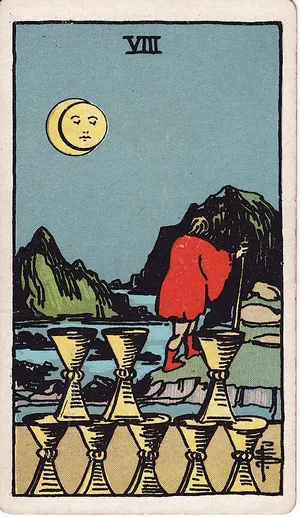

The Eight of Cups is one of the 56 Minor Arcana in the Rider–Waite–Smith tarot: the numbered card eight in the suit of Cups, drawn by Pamela Colman Smith and published in London in 1909. It shows a figure in a red cloak walking away, staff in hand, from eight stacked cups towards dark hills under a moon. Upright, it is usually read as leaving behind something that no longer satisfies; reversed, as hesitating to go, or turning back.
Key facts
- Suit: Cups, one of the four suits of 14 cards. Today’s common pairing links Cups with water, and the suit with feelings, relationships and the inner life; pairings differ between schools, as the 1909 Rider–Waite–Smith tarot article explains.
- Rank: a numbered card, the eight, between the Seven and the Nine of Cups. Like the other numbered cards it carries only a Roman numeral, VIII, at the top.
- Upright in one line: walking away from what you have built, in search of something that matters more.
- Reversed in one line: reluctance to leave, a return, or staying out of habit.
- Waite’s own key words (1910): “the decline of a matter”; a matter “thought to be important” that “is really of slight consequence”; reversed, “Great joy, happiness, feasting”.
What the picture shows
The sky is a flat grey-blue, with the numeral VIII at the top. In the upper left hangs a yellow disc with a calm face drawn on it, eyes lowered; a crescent is outlined inside its left edge, so a crescent and a round disc with a face appear together in one shape. Waite’s note on the card does not mention the moon.
In the foreground the eight cups stand on a tan ledge, all gold and of the same shape. Five make the lower row. Three stand on top of them, two on the left and one on the right, with a clear gap between them where another cup could have stood. The picture itself only shows that the stack is uneven.
Beyond the cups, a figure walks away from us. He wears a long red cloak and red boots and has fair hair; his right hand holds a tall staff. We see him only from behind, so the “dejected aspect” that Waite gives him has to be read from his posture: his head seems bent forward. He is crossing a stretch of grey rocks and water between the cups and the hills. To the left rises a green peak; ahead of him, on the right, a darker mountain, which is where he seems to be heading. Smith’s monogram is at the lower right.
Waite’s meanings in 1910
In Part III, §2 of The Pictorial Key to the Tarot, Waite’s note on the picture reads: “A man of dejected aspect is deserting the cups of his felicity, enterprise, under-taking or previous concern.” His divinatory meanings follow:
“The card speaks for itself on the surface, but other readings are entirely antithetical—giving joy, mildness, timidity, honour, modesty. In practice, it is usually found that the card shews the decline of a matter, or that a matter which has been thought to be important is really of slight consequence—either for good or evil. Reversed: Great joy, happiness, feasting.”
Two things stand out. Waite admits that the obvious reading, sadness and desertion, sits beside other readings that point the other way. And his own preferred meaning is quieter than abandonment: something fading, or turning out to matter less than it seemed, “either for good or evil”. The reversed meaning, “Great joy, happiness, feasting”, is the opposite of the picture.
Part III, §4, “Some Additional Meanings of the Lesser Arcana”, is a further set of meanings Waite lists for each card. For this one: “Marriage with a fair woman. Reversed: Perfect satisfaction.” These are period fortune-telling formulas, kept here as history. “Fair” most likely describes colouring: the Cups court cards in §2 are a “Fair man”, a “fair woman” and a “Fair young man”. Waite himself notes after the list that these additional meanings “have little connexion with the pictorial designs” and are “very often in disagreement with those previously given”.
How the card is usually read today
One common modern reading takes the Eight of Cups as a deliberate departure: the cups remain upright, yet the figure leaves them. In that reading the card is about recognising that something you invested in no longer feeds you, and choosing to look for what does. It is a prompt for reflection, not a sign that you will leave anything.
Upright. Readers often connect it with outgrowing a situation, a relationship or a goal; with disappointment that has settled into clarity; or with a search for meaning that the familiar cannot give. Waite’s “decline of a matter” fits here: the card can describe interest fading as much as a dramatic exit.
Reversed. Waite gives “Great joy, happiness, feasting”, the reverse of the scene. Later readings more often take the reversed card as the walk not taken: staying because leaving feels too costly, going back to what was left, or drifting from one thing to the next without knowing what you are looking for.
Questions people often take from the card:
- What here have I outgrown, even though it still looks complete?
- If I liken the gap between the cups to something missing, what comes to mind?
- If I stay, is it a choice, or the fear of the dark road?
Upright and reversed at a glance
| Upright | Reversed | |
|---|---|---|
| Waite, 1910 | The decline of a matter; something important that proves slight; also joy, mildness, modesty | Great joy, happiness, feasting |
| Common reading today | Walking away; outgrowing; seeking deeper meaning | Hesitating to leave; returning; aimless drifting |
| A question to ask | What no longer satisfies me here? | What keeps me from deciding either way? |
The Eight of Cups in a spread
Where the card falls changes the question it asks.
- Three cards (Past, Present, Future). In the Past position, it can point to something you left behind that still shapes your choices. In the Present, it asks whether something you are holding has quietly stopped mattering. In the Future position, readers usually take it as an invitation to name what you would be walking towards, not as a departure that has to happen.
- Celtic cross. In the Root position, it may invite a look at an old leaving, or an old wish to leave, under the present situation. In the Hopes position, it can ask whether you want change itself or the thing you imagine on the far side of it. In the Outcome position, many readers look at the cards beside it, especially any Cups card, to see what the journey is towards.
The positions of both spreads and the names of all 78 cards are in the tarot glossary; where the deck and its pictures come from is in the 1909 Rider–Waite–Smith tarot.
Cards often read next to the Eight of Cups
- Seven of Cups, the card before it: Waite’s Part III, §2 description of the Seven of Cups, “Strange chalices of vision”, where “nothing permanent or substantial is suggested”. Set beside it, the Eight shows cups left behind rather than visions in a cloud.
- Nine of Cups, the card after it: a figure seated in contentment before nine cups, the opposite mood to the one walking off.
- Eight of Swords: in Waite’s Part III, §2 entry for the Eight of Swords, a “woman, bound and hoodwinked”. Both are eights about staying or going; the Eight of Cups shows the figure already free to walk.
- Eight of Pentacles: in Waite’s Part III, §2 entry for the Eight of Pentacles, an “artist in stone at his work”, staying with a task instead of leaving it.
In HeyFate, each card you draw is turned upright or reversed at random with even odds, and an AI model writes the reading. This page is the reference behind the card, not a reading of your own question.
Sources
- A. E. Waite, The Pictorial Key to the Tarot, Part III, §2, “The Suit of Cups: Eight”, with lines from “Cups: Seven”, “Swords: Eight” and “Pentacles: Eight” (Wikisource, from the 1922 reprint)
- A. E. Waite, The Pictorial Key to the Tarot, Part III, §4, “Some Additional Meanings of the Lesser Arcana” (Wikisource, from the 1922 reprint)
- Wikimedia Commons: Cups08.jpg (Pam-A scan, public domain)
AI-generated content, for reference only; not medical, legal, financial or psychological advice. These methods come from cultural traditions, and HeyFate offers them for cultural interest, entertainment and self-reflection.