Eight of Pentacles Tarot Card Meaning: Upright, Reversed and Symbolism
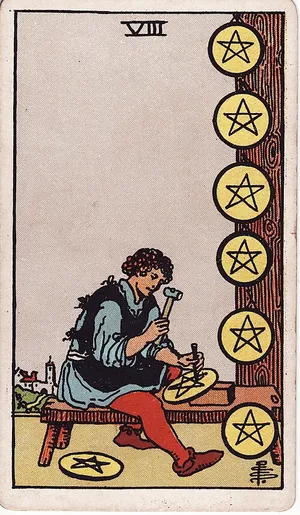

The Eight of Pentacles is one of the 56 Minor Arcana in the Rider–Waite–Smith tarot: the numbered card eight in the suit of Pentacles, drawn by Pamela Colman Smith and published in London in 1909. It shows a young man on a bench, cutting a star into a disc with hammer and chisel while the discs he has already made are set out around him. Upright, it is usually read as steady, absorbed work and a skill built through practice; reversed, as effort that has gone hollow, or cleverness put to poor use.
Key facts
- Suit: Pentacles, one of the four suits of 14 cards, usually connected with work, money, the body and the material side of life. Today’s common pairing links Pentacles with earth; other writers give other pairings, as the 1909 Rider–Waite–Smith tarot article shows.
- Rank: a numbered card, the eight, between the Seven and the Nine of Pentacles.
- Suit name: the suit was coins in many older decks; in his entry for the King of Pentacles, Waite notes that “In many old Tarot packs this suit stood for current coin, money, deniers”.
- Upright in one line: diligent work, practice, learning a trade properly.
- Reversed in one line: joyless routine, misplaced effort, skill turned to scheming.
- Waite’s own key words (1910): work, employment, commission, craftsmanship, “skill in craft and business, perhaps in the preparatory stage”.
What the picture shows
The background is a plain light grey, with the numeral VIII at the top. A young man with dark curly hair sits on a low wooden bench, bent over his work. He wears a blue shirt with rolled sleeves, a black apron, red hose and red shoes. One hand raises a hammer; the other sets a chisel on a disc propped up on the bench in front of him, and the star on that disc is already cut.
On the right, a thick wooden post runs from the top of the card almost to the ground. Six discs, each marked with a five-pointed star, are ranged down it from top to bottom. One more lies flat on the floor in front of the bench. With the disc in his hands, that makes eight. Waite’s note on the card is a single line: “An artist in stone at his work, which he exhibits in the form of trophies.” The scan does not show what the discs are made of; “stone” is Waite’s word.
Far off on the left, past a strip of green, stand a few red-roofed buildings and a pale tower. Waite says nothing about the distant town. The floor is a flat yellow-brown. Smith’s monogram is in the lower right corner.
Waite’s meanings in 1910
In Part III, §2 of The Pictorial Key to the Tarot, Waite’s entry for the card gives these divinatory meanings:
“Work, employment, commission, craftsmanship, skill in craft and business, perhaps in the preparatory stage. Reversed: Voided ambition, vanity, cupidity, exaction, usury. It may also signify the possession of skill, in the sense of the ingenious mind turned to cunning and intrigue.”
Waite returns to this picture in another entry. In Part III, §2, “The Suit of Pentacles: Three”, which shows “A sculptor at his work in a monastery”, he writes: “Compare the design which illustrates the Eight of Pentacles. The apprentice or amateur therein has received his reward and is now at work in earnest.” So in his own scheme the young man of the Eight is still learning.
In the reversed list, “cupidity” is greed, “exaction” is demanding more than is due, and “usury” is lending at excessive interest; the last sentence keeps the skill but bends it towards “cunning and intrigue”.
Part III, §4, “Some Additional Meanings of the Lesser Arcana”, adds a further list:
“A young man in business who has relations with the Querent; a dark girl. Reversed: The Querent will be compromised in a matter of money-lending.”
These are period fortune-telling formulas, kept here as history. “The Querent” is the person having the cards read; the lines say nothing about anyone reading this page, and this entry does not spell out what “dark” refers to. In §7 Waite sorts the court cards by hair, eyes and complexion, but that is a rule for choosing court cards, not a gloss on this line. The reversed line echoes “usury” in §2, so both lists tie money-lending to the reversed card.
How the card is usually read today
One common modern reading takes the Eight as the card of practice: the slow, repeated effort by which a skill becomes your own. Use it as a prompt for reflection; it does not foretell how any piece of work will turn out.
Upright. Readers often connect it with apprenticeship, training, a new course of study, concentrated work, attention to detail and the quiet pride of doing a task properly; following Waite’s “preparatory stage”, many put learning ahead of mastery. In his entry for the King of Pentacles Waite also remarks that “the cards do not happen to deal especially with questions of money”, and the Eight is often read in that spirit: about the craft rather than the pay.
Reversed. Later readings widen Waite’s greed and misused cleverness to work that has become routine and joyless, perfectionism that keeps anything from being finished, corners cut, or effort poured into something that no longer matters to you.
Questions people often take from the card:
- What am I practising at the moment, on purpose or by habit?
- Which part of my work deserves more patience than I have been giving it?
- Is the effort I put in still going towards something I care about?
Upright and reversed at a glance
| Upright | Reversed | |
|---|---|---|
| Waite, 1910 | Work, employment, craftsmanship; skill “perhaps in the preparatory stage” | Voided ambition, vanity, cupidity, usury; skill “turned to cunning and intrigue” |
| Common reading today | Practice, apprenticeship, careful and absorbed work | Joyless routine, perfectionism, cutting corners |
| A question to ask | What skill am I building, one piece at a time? | What is all this effort really serving? |
The Eight of Pentacles in a spread
- Three cards (Past, Present, Future). In the Past position, it can point to training or long practice that shaped what you are able to do now. In the Present, it asks what deserves your patient attention. In the Future position, readers usually take it as an invitation to decide what you are willing to keep practising, not as a promise of results.
- Celtic cross. In the Root position, the Eight invites a look at the habits and skills built up over time beneath the question. In the Challenge position, it can point to the tedium of repetition, or to polishing instead of finishing. In the Outcome position, many readers look at it with the cards beside it and ask what kind of steady, hands-on work the situation is calling for.
The positions of both spreads and the names of all 78 cards are in the tarot glossary; where the deck and its pictures come from is in the 1909 Rider–Waite–Smith tarot.
Cards often read next to the Eight of Pentacles
- Seven of Pentacles, the card before it: a young man leaning on his staff beside his pentacles, often read as pausing to weigh the effort so far.
- Nine of Pentacles, the card after it: a woman at ease among grapevines in a garden, often read as the comfort that long work can make room for.
- Three of Pentacles: the card Waite himself links to the Eight, where the apprentice “is now at work in earnest”.
- Eight of Wands: the same number in another suit, eight wands in flight, read as speed against this card’s steady pace.
In HeyFate, each card you draw is turned upright or reversed at random with even odds, and an AI model writes the reading. This page is the reference behind the card, not a reading of your own question.
Sources
- A. E. Waite, The Pictorial Key to the Tarot, Part III, §2, “The Suit of Pentacles: Eight”, also citing “The Suit of Pentacles: Three” and “The Suit of Pentacles: King” (Wikisource, from the 1922 reprint)
- A. E. Waite, The Pictorial Key to the Tarot, Part III, §4, “Some Additional Meanings of the Lesser Arcana” (Wikisource, from the 1922 reprint)
- A. E. Waite, The Pictorial Key to the Tarot, Part III, §7, “An Ancient Celtic Method of Divination” (Wikisource, from the 1922 reprint)
- Wikimedia Commons: Pents08.jpg (Pam-A scan, public domain)
AI-generated content, for reference only; not medical, legal, financial or psychological advice. These methods come from cultural traditions, and HeyFate offers them for cultural interest, entertainment and self-reflection.