Eight of Wands Tarot Card Meaning: Upright, Reversed and Symbolism
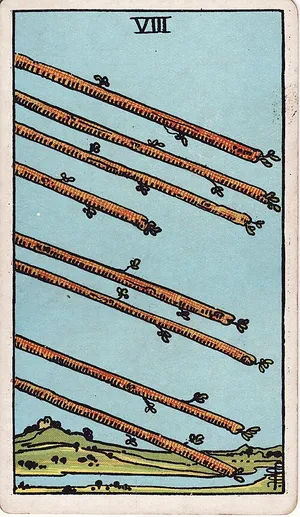

The Eight of Wands is a numbered card in the suit of Wands, one of the four suits that make up the 56 Minor Arcana in the Rider–Waite–Smith tarot, drawn by Pamela Colman Smith and published in London in 1909. It shows eight leafy staves flying in parallel through a clear sky above a river valley, with no person anywhere in the picture. Upright, it is usually read as speed, momentum and news on its way; reversed, as that movement stalled, scattered or turned into friction.
Key facts
- Suit: Wands. The pairing commonly given today is Fire, but writers differ and his entries for the suit do not name one; see the 1909 Rider–Waite–Smith tarot. In his entry for the Queen of Wands, Waite says the wands of this suit are “always in leaf, as it is a suit of life and animation”. Today the suit is usually linked with energy, drive, work and plans.
- Rank: a numbered card, VIII, between the Seven and the Nine of Wands.
- Upright in one line: movement, speed, things arriving or coming together quickly.
- Reversed in one line: delay, haste that misfires, friction and jealousy.
- Waite’s own key words (1910, shortened): “Activity in undertakings”, swiftness, “great haste, great hope”; “also the arrows of love”.
What the picture shows
There is no human figure on this card, which makes it one of the very few numbered cards in the deck without one. Eight long wooden staves cross the card in parallel lines, slanting down from the upper left towards the lower right. Their back ends run off the left edge, as if they had come from outside the frame, and their front ends tilt towards the ground on the right. They are not evenly spaced: four fly close together near the top, then come two, then two more lower down. Each staff carries small green sprigs of leaves along its length. The Roman numeral VIII sits at the top against a pale blue sky.
Below the staves lies a strip of green country. A river runs across the foreground from left to right, and on the left a low hill is topped by a small building; dark bushes or trees dot the slopes. The lowest staff points towards the river at the lower right, close to Smith’s monogram.
Waite’s own note on the picture is short: the card “represents motion through the immovable—a flight of wands through an open country; but they draw to the term of their course. That which they signify is at hand; it may be even on the threshold.” The downward slant of the staves can suggest a landing rather than a take-off, which fits his phrase about the end of their course; that reading of the slant is ours, not his. The idea that they are arrows, which later readings often take up, has a root in Waite’s own list, where he names “the arrows of love” upright and “Arrows of jealousy” reversed.
Waite’s meanings in 1910
In Part III, §2 of The Pictorial Key to the Tarot, Waite gives the divinatory meanings:
“Activity in undertakings, the path of such activity, swiftness, as that of an express messenger; great haste, great hope, speed towards an end which promises assured felicity; generally, that which is on the move; also the arrows of love. Reversed: Arrows of jealousy, internal dispute, stingings of conscience, quarrels; and domestic disputes for persons who are married.”
An express messenger was a courier sent by the fastest means to hand, and the phrase is one reason the card is still tied to messages and news. The reversed list turns the same arrows inward: jealousy, an uneasy conscience, quarrels close to home.
Section 4, “Some Additional Meanings of the Lesser Arcana”, is a further set of meanings Waite lists for each card; after the list he notes that they “are very often in disagreement with those previously given”. For this card it is one line:
“Eight.—Domestic disputes for a married person.”
These §4 lines are period fortune-telling formulas, kept here as history, not as anything about the reader. Here the line simply repeats the end of the §2 reversed list, now without the word “Reversed”.
How the card is usually read today
One common modern reading treats the Eight of Wands as the card of momentum: after the effort and standoffs of the earlier Wands, things are moving at last, and fast. Many readers link it with messages, travel, quick decisions and several threads coming together at once. Read it as a prompt to look at the pace of your own situation, not as a forecast of what is about to arrive.
Upright. Common readings are a burst of progress, replies coming in, plans that suddenly pick up speed, or a sense that the way ahead is open, as the empty sky on the card suggests. Some readers follow Waite’s “arrows of love” and read it as a quickening interest in someone; others keep it to work and plans.
Reversed. Waite’s reversed list is about jealousy and quarrels. Later readings more often take the reversed Eight as movement gone wrong: delays, crossed messages, rushing that causes mistakes, or energy scattered in too many directions. Some readers also bring in Waite’s “stingings of conscience”: something done in haste that now nags at you.
Questions people often take from the card:
- What is already moving here, and am I keeping up with it or holding it back?
- Is the speed I feel helping me, or pushing me to decide before I am ready?
- Which message, reply or step have I been putting off?
Upright and reversed at a glance
| Upright | Reversed | |
|---|---|---|
| Waite, 1910 | Activity, swiftness, great haste, great hope; the arrows of love | Arrows of jealousy, internal dispute, stingings of conscience, quarrels |
| Common reading today | Momentum, news, quick progress | Delay, crossed messages, haste that misfires |
| A question to ask | Where is this moving, and am I ready for it? | What is slowing this down, or what am I rushing? |
The Eight of Wands in a spread
Position changes the question the card asks.
- Three cards (Past, Present, Future). In the Past position, it can invite a look at a period when things moved quickly, and at what that speed left behind. In the Present, it asks how you are handling the current pace. In the Future position, readers usually take it as a prompt to get ready for movement you can already see starting, not as a fixed event.
- Celtic cross. In the Challenge position, it may point to the pressure of speed: too much arriving at once, or a decision being hurried. In the Environment position, it can ask what is moving around you that you do not control. In the Outcome position, many readers look at the cards near it to judge whether the movement is being steered or simply carried along.
The positions of both spreads and the names of all 78 cards are in the tarot glossary; where the deck and its pictures come from is in the 1909 Rider–Waite–Smith tarot.
Cards often read next to the Eight of Wands
- Seven of Wands, the card before it: a man on high ground fending off six staves raised from below; set beside it, the Eight shows staves with no one holding them, all moving the same way.
- Nine of Wands, the card after it: eight staves standing upright “like a palisade”, in Waite’s phrase, with a wary man in front of them.
- Eight of Swords: the same number in another suit, but a bound, blindfolded woman standing among swords; readers sometimes set the two side by side as speed against standstill.
- Eight of Cups: a figure walking away from stacked cups under the moon; movement again, but slow and chosen.
In HeyFate, each card you draw is turned upright or reversed at random with even odds, and an AI model writes the reading. This page is the reference behind the card, not a reading of your own question.
Sources
- A. E. Waite, The Pictorial Key to the Tarot, Part III, §2, “The Suit of Wands: Eight”, with the Queen of Wands entry on the suit and one phrase from “Wands: Nine” (Wikisource, from the 1922 reprint)
- A. E. Waite, The Pictorial Key to the Tarot, Part III, §4, “Some Additional Meanings of the Lesser Arcana” (Wikisource, from the 1922 reprint)
- Wikimedia Commons: Wands08.jpg (Pam-A scan, public domain)
AI-generated content, for reference only; not medical, legal, financial or psychological advice. These methods come from cultural traditions, and HeyFate offers them for cultural interest, entertainment and self-reflection.