Nine of Wands Tarot Card Meaning: Upright, Reversed and Symbolism
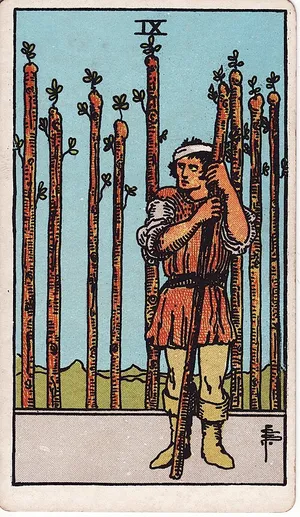

The Nine of Wands is a numbered card in the suit of Wands, one of the four suits that make up the 56 Minor Arcana in the Rider–Waite–Smith tarot, drawn by Pamela Colman Smith and published in London in 1909. It shows a man with a bandage round his head, gripping a staff and glancing sideways, with eight more staves standing in a row behind him. Upright, it is usually read as resilience and holding your ground near the end of a long effort; reversed, as that guard worn down into exhaustion, suspicion or the wish to give up.
Key facts
- Suit: Wands. The pairing commonly given today is Fire, but writers differ and his entries for the suit do not name one; see the 1909 Rider–Waite–Smith tarot. In his entry for the Queen of Wands, Waite calls it “a suit of life and animation”, and today it is usually linked with energy, drive, work and plans.
- Rank: a numbered card, IX, between the Eight and the Ten of Wands.
- Upright in one line: endurance, vigilance, standing firm with what you have built.
- Reversed in one line: fatigue, defensiveness that has gone too far, obstacles piling up.
- Waite’s own key words (1910, shortened): “strength in opposition”; “delay, suspension, adjournment”; reversed, “Obstacles, adversity, calamity”.
What the picture shows
A young man stands in the foreground on a strip of pale grey ground. He wears a red-brown tunic with a black belt, short, puffed white sleeves that leave his forearms bare, and pale leggings and boots. A white bandage is tied round his head over dark hair. He holds a tall staff upright in front of his body with both hands, one above the other, so that it runs from his feet to well above his head, and he turns his eyes to the side with a guarded, watchful expression.
Behind him eight more staves stand upright in a row on green ground. Like all the wands in this suit they sprout small green leaves, most of them near the top. Beyond the staves a low band of green hills runs along the horizon under a blue sky. Smith’s monogram sits on the grey ground at the lower right.
Waite’s note describes the scene closely: “The figure leans upon his staff and has an expectant look, as if awaiting an enemy. Behind are eight other staves—erect, in orderly disposition, like a palisade.” A palisade is a fence of stakes put up for defence, which is what the row behind him looks like. In the scan he holds the staff close to his chest. Waite does not mention the bandage.
Waite’s meanings in 1910
In Part III, §2 of The Pictorial Key to the Tarot, Waite gives the divinatory meanings:
“The card signifies strength in opposition. If attacked, the person will meet an onslaught boldly; and his build shews that he may prove a formidable antagonist. With this main significance there are all its possible adjuncts—delay, suspension, adjournment. Reversed: Obstacles, adversity, calamity.”
Two things stand out. Waite reads the figure through his body: “his build shews” that he can hold his own. And the “adjuncts” he lists, delay, suspension, adjournment, are all forms of waiting. Strength here is not attack but the ability to stand and wait under pressure.
Section 4, “Some Additional Meanings of the Lesser Arcana”, is a further set of meanings Waite lists for each card; after the list he notes that they “are very often in disagreement with those previously given”. For the Nine it is blunt:
“Nine.—Generally speaking, a bad card.”
These §4 lines are period fortune-telling formulas, kept here as history, not as anything about the reader. Set beside §2, the line shows how far the two lists can disagree: one gives a capable defender, the other simply a bad card.
How the card is usually read today
One common modern reading sees the Nine of Wands as the last stretch of a hard effort: you have come a long way, you carry the marks of it, and you are not ready to let go of what you have built. In that reading the card is about resilience and boundaries more than about enemies. Use it to reflect on your own position, not as a forecast of trouble.
Upright. Common readings are persistence, staying alert, defending your work or your limits, or finding that you have more strength left than you thought. The picture gives its own prompt: a bandaged figure who still holds his staff and keeps watch.
Reversed. Waite gives “Obstacles, adversity, calamity”. Later readings more often take the reversed Nine as the guard worn thin: exhaustion, feeling that every request is an attack, refusing help, or being tempted to drop everything just before the end. Some read it as a cue to rest or to let someone else share the watch.
Questions people often take from the card:
- What am I protecting here, and is it still worth the effort?
- Am I meeting a real threat, or bracing out of habit?
- Who could stand beside me for this last part?
Upright and reversed at a glance
| Upright | Reversed | |
|---|---|---|
| Waite, 1910 | Strength in opposition; delay, suspension, adjournment | Obstacles, adversity, calamity |
| Common reading today | Resilience, vigilance, holding your ground | Exhaustion, over-defensiveness, wanting to give up |
| A question to ask | What am I guarding, and why? | Where do I need rest or help? |
The Nine of Wands in a spread
Each position gives the card a different question.
- Three cards (Past, Present, Future). In the Past position, it can invite a look at an old struggle and the habits of guarding it left behind. In the Present, it asks how much strength you have left and where you are spending it. In the Future position, readers usually take it as a prompt to prepare for a stretch that needs patience, not as a fixed event.
- Celtic cross. In the Challenge position, it may point to weariness, or to a defensiveness that makes things harder than they need to be. In the Self position, it can ask how you see yourself under pressure. In the Outcome position, many readers look at the cards around it to see whether the watch can soon be eased.
The positions of both spreads and the names of all 78 cards are in the tarot glossary; where the deck and its pictures come from is in the 1909 Rider–Waite–Smith tarot.
Cards often read next to the Nine of Wands
- Eight of Wands, the card before it: the staves in flight; the Nine instead shows a stationary row with a watchful figure in front.
- Ten of Wands, the card after it: a man carrying all ten staves, bent under their weight; the two pictures contrast keeping watch with carrying a heavy load.
- Nine of Swords: the same number in another suit, a figure sitting up in bed with face in hands; worry at night where the Nine of Wands keeps watch by day.
- Nine of Pentacles: a woman at ease in a vineyard, a bird on her glove; another Nine, but secure rather than on guard.
In HeyFate, each card you draw is turned upright or reversed at random with even odds, and an AI model writes the reading. This page is the reference behind the card, not a reading of your own question.
Sources
- A. E. Waite, The Pictorial Key to the Tarot, Part III, §2, “The Suit of Wands: Nine”, with the Queen of Wands entry on the suit (Wikisource, from the 1922 reprint)
- A. E. Waite, The Pictorial Key to the Tarot, Part III, §4, “Some Additional Meanings of the Lesser Arcana” (Wikisource, from the 1922 reprint)
- Wikimedia Commons: Wands09.jpg (Pam-A scan, public domain)
AI-generated content, for reference only; not medical, legal, financial or psychological advice. These methods come from cultural traditions, and HeyFate offers them for cultural interest, entertainment and self-reflection.