Eight of Swords Tarot Card Meaning: Upright, Reversed and Symbolism
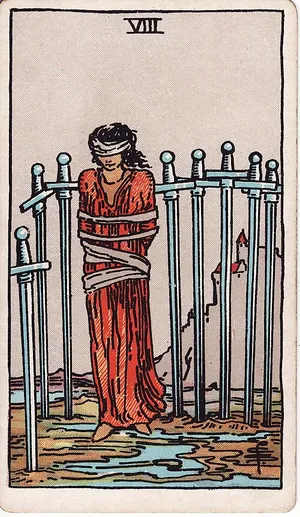

The Eight of Swords is a numbered card in the suit of Swords, one of the four suits of 14 cards that make up the 56 Minor Arcana of the Rider–Waite–Smith tarot, drawn by Pamela Colman Smith and published in London in 1909. It shows a woman in a red robe, blindfolded and bound, standing among eight swords planted in wet ground. Upright, it is usually read as feeling trapped by a situation that may be less closed than it looks; reversed, as the bonds starting to loosen, or as the same fear pulled tighter.
Key facts
- Suit: Swords, a suit usually linked with thought, words, conflict and hard decisions. Today’s common pairing gives Swords the element of Air, but schools differ (Papus put Swords with Earth); see the 1909 Rider–Waite–Smith tarot.
- Rank and place: a numbered card, with VIII printed at the top; it comes after the Seven of Swords and before the Nine.
- Upright in one line: feeling hemmed in, unable to see a way out, waiting to be freed.
- Reversed in one line: the binding loosens and options come into view; or worry turns inward and grows harder to name.
- Waite’s own key words (1910, selected): bad news, crisis, censure, “power in trammels”, calumny; and “rather a card of temporary durance than of irretrievable bondage”.
What the picture shows
Smith set the scene under a flat, pale grey sky. In the middle stands a woman with dark, loose hair and a white cloth tied over her eyes. Her red-orange robe is wrapped with broad grey bands from the upper arms down to the hips, so her arms are pinned against her body and hidden. Below the hips the robe hangs free, and her feet show at the hem: nothing is tied around her legs.
Eight swords stand upright with their points in the ground, three on the left as we look at the card and five on the right. Their pale blue blades rise to about the height of her head, and one crossguard on the left is tipped at an angle. The swords stand beside and behind her; the ground directly in front of her is open. She stands on brown, sodden earth with shallow pools of blue water around her feet. On the right, behind the swords, a grey crag rises to a castle with red roofs; low hills run along the horizon on the left. The Roman numeral VIII is at the top, and Smith’s monogram sits in the lower right corner.
Waite’s note for the card is short: “A woman, bound and hoodwinked, with the swords of the card about her.” He adds straight away: “Yet it is rather a card of temporary durance than of irretrievable bondage.” Durance is an old word for confinement. Waite himself does not explain the open ground, the castle or the water.
Waite’s meanings in 1910
At the opening of Part III, §2 of The Pictorial Key to the Tarot, Waite says that for the Minor Arcana “a harmony of their meanings will be provided from all sources”. For the Eight of Swords he gives:
“Bad news, violent chagrin, crisis, censure, power in trammels, conflict, calumny; also sickness. Reversed: Disquiet, difficulty, opposition, accident, treachery; what is unforeseen; fatality.”
The list is harsher than his picture note. Chagrin here means bitter vexation, calumny means slander, and “power in trammels” means power held in fetters, which is the phrase closest to the image: a figure with strength who cannot use it. The card fits a remark Waite makes in his entry for the Two of Swords, that “Swords generally are not symbolical of beneficent forces in human affairs”. The word “sickness” belongs to the same period vocabulary and says nothing about anyone’s health.
In §4, “Some Additional Meanings of the Lesser Arcana”, he lists a further set of meanings, which he says are “very often in disagreement with those previously given”: “For a woman, scandal spread in her respect. Reversed: Departure of a relative.” These are fortune-telling formulas from the cartomancy of his day, with its stock situations for women and families. They are kept here as history, not as anything about the person who draws the card.
How the card is usually read today
One common modern reading takes the Eight of Swords as a trap that is partly made of thought: the situation is hard, but the feeling of having no way out comes as much from the blindfold as from the swords. Read it as a prompt for reflection, not as a verdict on where you stand.
Upright. Readers often connect it with indecision, a sense of powerlessness, waiting for permission or rescue, or the fear that any move will make things worse. Some look at the open ground in front of the figure and ask what one small step would be possible without seeing the whole way.
Reversed. Waite’s reversed list, “Disquiet, difficulty, opposition”, stays heavy. Later readings go two ways: the binding slipping and the blindfold coming off, a first clear look at the options; or anxiety that has gone further inward and become harder to talk about. The cards around it usually decide which way a reader leans.
Questions to sit with:
- Which of the limits here have I tested, and which have I only assumed?
- What would I do next if I could see a little more of the ground ahead?
- Whose permission, or whose rescue, am I waiting for before I move?
Upright and reversed at a glance
| Upright | Reversed | |
|---|---|---|
| Waite, 1910 | Bad news, crisis, censure, power in trammels, calumny | Disquiet, difficulty, opposition, accident, treachery |
| Common reading today | Feeling trapped; indecision; a limit partly of one’s own making | Release beginning; or fear turned further inward |
| A question to ask | Which limit have I actually tested? | What is loosening, and what still holds me? |
The Eight of Swords in a spread
The same picture asks something different in each position.
- Three cards (Past, Present, Future). In the Past position, it can invite a look at a time of feeling stuck and at how you came through it. In the Present, it asks where you feel boxed in now and what might be covering your eyes. In the Future position, readers usually take it as a prompt to notice where you could talk yourself out of moving, not as a fixed event.
- Celtic cross. In the Challenge position, it can point to a belief or a fear that stands across the whole matter. In the Self position, it may ask how much room for choice you allow yourself. In the Outcome position, many readers look back at the Self and Hopes cards to see what is holding the picture in place.
The positions of both spreads and the names of all 78 cards are in the tarot glossary; where the deck and its pictures come from is in the 1909 Rider–Waite–Smith tarot.
Cards often read next to the Eight of Swords
- Seven of Swords, the card before it: Waite’s entry has “A man in the act of carrying away five swords rapidly”. Readers often set that quick escape against the Eight’s stillness.
- Nine of Swords, the card after it: the trouble moves indoors, to a sleepless night.
- Two of Swords: Waite’s entry begins “A hoodwinked female figure”; both cards are often read as not seeing clearly, the Two as a held balance, the Eight as a constraint.
- Eight of Cups: the same rank in Cups, where Waite’s figure “is deserting the cups”; often read as walking away, against the Eight of Swords’ feeling that one cannot move.
In HeyFate, each card you draw is turned upright or reversed at random with even odds, and an AI model writes the reading. This page is the reference behind the card, not a reading of your own question.
Sources
- A. E. Waite, The Pictorial Key to the Tarot, Part III, §2, “The Suit of Swords: Eight”, also citing “The Suit of Swords: Two” and “Seven”, and “The Suit of Cups: Eight” (Wikisource, from the 1922 reprint)
- A. E. Waite, The Pictorial Key to the Tarot, Part III, §4, “Some Additional Meanings of the Lesser Arcana” (Wikisource, from the 1922 reprint)
- Wikimedia Commons: Swords08.jpg (Pam-A scan, public domain)
AI-generated content, for reference only; not medical, legal, financial or psychological advice. These methods come from cultural traditions, and HeyFate offers them for cultural interest, entertainment and self-reflection.