Seven of Swords Tarot Card Meaning: Upright, Reversed and Symbolism
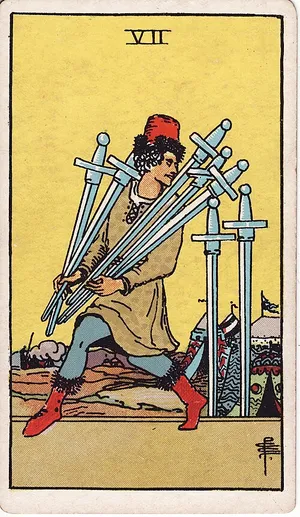

The Seven of Swords is the seventh card of the suit of Swords, one of the four suits that make up the 56 Minor Arcana in the Rider–Waite–Smith tarot, drawn by Pamela Colman Smith and published in London in 1909. It shows a man hurrying away from a camp with an armful of five swords, looking back over his shoulder, while two swords stay planted in the ground behind him. Upright, it is usually read as a plan carried out quietly, strategy or stealth, sometimes deception; reversed, as a scheme coming to light, second thoughts, or advice worth hearing.
Key facts
- Suit: Swords, 14 cards. Readers today commonly associate the suit with thought, speech, decisions and conflict. Today’s common pairing is Air, but schools differ: Papus paired Swords with Earth, and Waite does not specify an element for Swords in this book (see the 1909 Rider–Waite–Smith tarot). In his entry for the Two of Swords, Waite warns that “Swords generally are not symbolical of beneficent forces in human affairs”.
- Rank: Seven, a numbered card, with the Roman numeral VII at the top and no title.
- Upright in one line: a plan, a risk, acting alone or by stealth.
- Reversed in one line: coming clean, a plan rethought, counsel taken or ignored.
- Waite’s own key words (1910): design, attempt, wish, hope, confidence; also quarrelling, “a plan that may fail”; reversed, “Good advice, counsel, instruction”.
What the picture shows
The background is a bright, flat yellow. A man strides across the middle of the card towards the viewer’s left, legs wide apart: the front foot steps out to the left, and the back leg is bent behind him with the heel raised, as if he were moving fast and lightly. He wears a long tan tunic, blue-grey hose, red shoes trimmed with dark fur at the ankles, and a tall red cap over dark curly hair. While his body heads left, his head is turned back to the right, towards the camp, and his mouth is set in a small smile.
He clutches five swords in both arms, the bundle held low in front of him, with the hilts sticking up past his shoulders on either side. Behind him, on the viewer’s right, two more swords stand upright in the ground. Waite’s note says: “A man in the act of carrying away five swords rapidly; the two others of the card remain stuck in the ground. A camp is close at hand.”
The camp is at the right: tents decorated with zigzags, wavy lines and spots, with small flags on top. On the far left, in the distance, a grey cloud of smoke or dust rises over the hills, with a few small dark shapes beneath it that could be people; the scan is too small to be sure. The ground runs in bands of brown, orange and green. Smith’s monogram is at the lower right, and VII at the top.
Waite’s meanings in 1910
In Part III, §2 of The Pictorial Key to the Tarot, Waite gives the divinatory meanings of the Seven of Swords:
“Design, attempt, wish, hope, confidence; also quarrelling, a plan that may fail, annoyance. The design is uncertain in its import, because the significations are widely at variance with each other. Reversed: Good advice, counsel, instruction, slander, babbling.”
The word “design” appears twice and means two things. In the list, a design is a plan or scheme. In the next sentence, “the design” is the card’s own picture, which Waite admits is hard to pin down, because its meanings “are widely at variance with each other”: hope and confidence sit next to quarrelling and a plan that may fail. The reversed list is just as mixed, running from good advice to slander and babbling. Waite does not call the man a thief; he only says he is carrying the swords away “rapidly”.
In §4, “Some Additional Meanings of the Lesser Arcana”, Waite lists a further set of meanings, which he says are “very often in disagreement with those previously given”. For the Seven:
“Dark girl; a good card; it promises a country life after a competence has been secured. Reversed: Good advice, probably neglected.”
A “competence” here means enough money to live on. These are period fortune-telling formulas, kept here as history, including its period character types; none of it is a promise about your life.
How the card is usually read today
One common modern reading takes the Seven of Swords as the card of strategy and stealth: getting something done quietly, sometimes cleverly, sometimes at someone else’s expense. In that reading the backward glance matters as much as the swords: he knows he might be seen. Read it as a prompt for reflection, not a forecast.
Upright. Readers often connect it with working around an obstacle rather than through it, keeping a plan to yourself, taking a calculated risk, or acting alone. Some read a darker side: cutting corners, being less than honest, or suspecting that someone else is. Others note that he leaves two swords behind, and ask what cannot be carried off.
Reversed. Waite’s reversed list begins with “Good advice, counsel, instruction”. Later readings more often take the reversed Seven as a plan coming into the open: owning up, being found out, a change of heart, or deciding that the quiet way is not worth it. Some read it as advice you are tempted to ignore, which happens to echo the §4 line.
Questions people often take from the card:
- What am I trying to carry off on my own, and why not openly?
- Who would I not want to see what I am doing here?
- Is there a piece of advice I have been avoiding?
Upright and reversed at a glance
| Upright | Reversed | |
|---|---|---|
| Waite, 1910 | Design, attempt, wish, hope, confidence; quarrelling, a plan that may fail, annoyance | Good advice, counsel, instruction, slander, babbling |
| Common reading today | Strategy, stealth, a risky plan; sometimes deception | Coming clean; a plan rethought; advice to heed |
| A question to ask | What am I doing out of sight? | What would happen if I said it openly? |
The Seven of Swords in a spread
The card often asks how openly something is being done, and by whom.
- Three cards (Past, Present, Future). In the Past position, it can point to a plan made quietly that still affects things, or to trust that was strained. In the Present, it asks what is being held back, by you or by others. In the Future position, readers usually take it as a prompt to think through a plan and its risks before acting, not as a fixed event.
- Celtic cross. In the Self position, it may ask whether you are going it alone when you need not. In the Environment position, some readers take it as a sign to look carefully at what others are telling you. In the Challenge position, it can point to a shortcut that may cost more than it saves.
The positions of both spreads and the names of all 78 cards are in the tarot glossary; where the deck and its pictures come from is in the 1909 Rider–Waite–Smith tarot.
Cards often read next to the Seven of Swords
- Six of Swords, the card before it: an open crossing with help. The Seven moves alone and quickly.
- Eight of Swords, the card after it: in §2, “The Suit of Swords: Eight”, Waite describes “A woman, bound and hoodwinked”, but “rather a card of temporary durance than of irretrievable bondage”.
- Seven of Wands: the same rank in Wands, often read as holding your ground openly, where the Seven of Swords slips away.
- Seven of Cups: the same rank in Cups, often read as many tempting options; both cards ask how realistic a plan is.
In HeyFate, each card you draw is turned upright or reversed at random with even odds, and an AI model writes the reading. This page is the reference behind the card, not a reading of your own question.
Sources
- A. E. Waite, The Pictorial Key to the Tarot, Part III, §2, “The Suit of Swords: Seven”, with short quotations from the entries for the Two and Eight of Swords (Wikisource, from the 1922 reprint)
- A. E. Waite, The Pictorial Key to the Tarot, Part III, §4, “Some Additional Meanings of the Lesser Arcana” (Wikisource, from the 1922 reprint)
- Wikimedia Commons: Swords07.jpg (Pam-A scan, public domain)
AI-generated content, for reference only; not medical, legal, financial or psychological advice. These methods come from cultural traditions, and HeyFate offers them for cultural interest, entertainment and self-reflection.