Six of Swords Tarot Card Meaning: Upright, Reversed and Symbolism
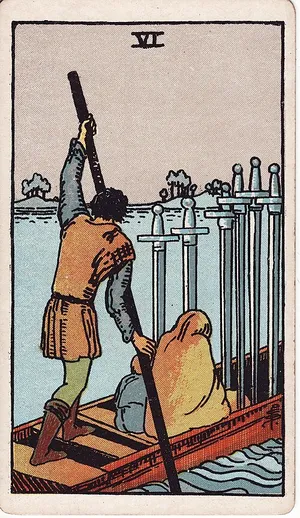

The Six of Swords is the sixth card of the suit of Swords, one of the four suits that make up the 56 Minor Arcana in the Rider–Waite–Smith tarot, drawn by Pamela Colman Smith and published in London in 1909. It shows a ferryman poling a flat boat towards a far shore, with two huddled passengers and six upright swords on board. Upright, it is usually read as a transition, moving away from difficulty towards calmer ground; reversed, as a move that is stalled or resisted, or something left unresolved behind you.
Key facts
- Suit: Swords, 14 cards. Readers today commonly associate the suit with thought, speech, decisions and conflict. Today’s common pairing is Air, but schools differ: Papus paired Swords with Earth, and Waite does not specify an element for Swords in this book (see the 1909 Rider–Waite–Smith tarot). In his entry for the Two of Swords, Waite warns that “Swords generally are not symbolical of beneficent forces in human affairs”.
- Rank: Six, a numbered card, with the Roman numeral VI at the top and no title.
- Upright in one line: passage, moving on, leaving rough water for smoother.
- Reversed in one line: a crossing delayed, resistance to leaving, or something unsaid coming out.
- Waite’s own key words (1910): journey by water, route, way, envoy; reversed, “Declaration, confession, publicity”.
What the picture shows
A man stands at the back of a long, flat boat, seen from behind. He wears an orange tunic over grey sleeves, green hose and brown boots, and he holds a long black pole in both hands, one high and one low, its end pushed down into the water. The boat’s side is a deep red, with a dark pattern along the rim.
In front of him, two passengers sit low in the boat with their backs to us. One is a hunched figure wrapped from head to foot in a hooded cloak of orange and yellow; the other, smaller, is dressed in grey and sits close beside it. Their faces are not visible, and Waite does not identify their ages or relationship. Six swords stand upright in the boat, grouped in front of the passengers, their hilts at the top and their blades running down into the hull.
Ahead lies a wide stretch of calm, pale water and, beyond it, a low shore with a few trees. The sky is a flat grey. On the viewer’s right, beside the boat, the water is drawn in wavy lines, while further out it lies smooth. Waite describes the course as smooth and does not explain the difference in the water. Smith’s monogram is on the side of the boat, at the right, and the Roman numeral VI is at the top.
Waite’s note: “A ferryman carrying passengers in his punt to the further shore. The course is smooth, and seeing that the freight is light, it may be noted that the work is not beyond his strength.” A punt is a flat-bottomed boat moved with a pole, as here.
Waite’s meanings in 1910
In Part III, §2 of The Pictorial Key to the Tarot, Waite gives the divinatory meanings of the Six of Swords:
“Journey by water, route, way, envoy, commissionary, expedient. Reversed: Declaration, confession, publicity; one account says that it is a proposal of love.”
The upright list is literal and practical: a trip by water, a route, someone sent on an errand (an “envoy” or “commissionary”), a means to an end. It is gentler than much of a suit he warns is not generally “beneficent”. The reversed list turns from movement to speech: something declared, confessed or made public, or, by one account, a declaration of love.
§4, “Some Additional Meanings of the Lesser Arcana”, is a further set of meanings Waite lists; he notes that they are “very often in disagreement with those previously given”. For the Six:
“The voyage will be pleasant. Reversed: Unfavourable issue of lawsuit.”
These are period fortune-telling formulas, kept here as history. They are worded as forecasts because that was the trade they came from; this page does not read them as forecasts about you.
How the card is usually read today
One common modern reading takes the Six of Swords as a crossing: leaving a hard place behind and moving, slowly and with help, towards somewhere quieter. In that reading the swords are not left behind; they travel with the passengers, and the card is about carrying what happened while still moving on. Use it for reflection, not as a forecast.
Upright. Readers often connect it with a transition, recovering after a difficult period, a change of scene, accepting help, or a gradual shift from turmoil to calm. Some point to the ferryman and read the card as someone, or something, steady that gets you across.
Reversed. Waite’s reversed meanings are about things coming into the open. Later readings more often take the reversed Six as a crossing that is stalled: not being ready to leave, being pulled back to old trouble, or a move that keeps being put off. Some combine the two, reading it as unfinished business that needs to be said before you can go.
Questions people often take from the card:
- What am I moving away from, and what am I moving towards?
- Which of my swords am I carrying with me to the other side?
- Who or what is helping me across, and have I let them?
Upright and reversed at a glance
| Upright | Reversed | |
|---|---|---|
| Waite, 1910 | Journey by water, route, way, envoy, commissionary, expedient | Declaration, confession, publicity; a proposal of love |
| Common reading today | Transition; moving on; calmer water ahead | A stalled crossing; reluctance to leave; something unresolved |
| A question to ask | What am I leaving behind? | What still needs to be said before I can go? |
The Six of Swords in a spread
The card often marks where a change sits in the story.
- Three cards (Past, Present, Future). In the Past position, it can point to a move or transition that brought you to where you are. In the Present, it asks what kind of crossing you are in the middle of. In the Future position, readers usually take it as an invitation to consider what a calmer next stage would look like, not as a fixed event or a trip that must happen.
- Celtic cross. In the Past position, it may describe a time of leaving something behind. In the Hopes position, it can ask what kind of relief you are hoping for. In the Outcome position, many readers look at the Environment card beside it and ask who is helping with the crossing.
The positions of both spreads and the names of all 78 cards are in the tarot glossary; where the deck and its pictures come from is in the 1909 Rider–Waite–Smith tarot.
Cards often read next to the Six of Swords
- Five of Swords, the card before it: a quarrel and two figures walking towards the water. The Six is often read as the crossing that follows.
- Seven of Swords, the card after it: swords carried off in a hurry, often read as a less open way of getting what you want.
- Six of Cups: the same rank in Cups, often read as looking back to the past, where the Six of Swords is moving away from it.
- Six of Wands: the same rank in Wands, often read as public recognition, a very different kind of journey.
In HeyFate, each card you draw is turned upright or reversed at random with even odds, and an AI model writes the reading. This page is the reference behind the card, not a reading of your own question.
Sources
- A. E. Waite, The Pictorial Key to the Tarot, Part III, §2, “The Suit of Swords: Six”, with a short quotation from the entry for the Two of Swords (Wikisource, from the 1922 reprint)
- A. E. Waite, The Pictorial Key to the Tarot, Part III, §4, “Some Additional Meanings of the Lesser Arcana” (Wikisource, from the 1922 reprint)
- Wikimedia Commons: Swords06.jpg (Pam-A scan, public domain)
AI-generated content, for reference only; not medical, legal, financial or psychological advice. These methods come from cultural traditions, and HeyFate offers them for cultural interest, entertainment and self-reflection.