Six of Wands Tarot Card Meaning: Upright, Reversed and Symbolism
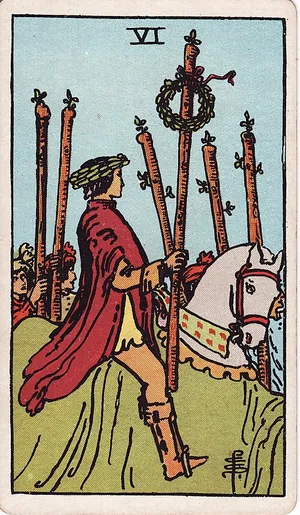

The Six of Wands is the sixth card of the suit of Wands, one of the four suits of 14 cards that make up the 56 Minor Arcana in the Rider–Waite–Smith tarot, drawn by Pamela Colman Smith and published in London in 1909. It shows a rider wearing a laurel wreath on a white horse, holding up a staff crowned with another wreath, with men on foot carrying staves around him. Upright, it is usually read as victory, recognition and confidence after effort; reversed, as unease, recognition withheld, or a success that keeps being put off.
Key facts
- Suit: Wands, often linked today with energy, drive, ambition and creative work. Fire is today’s common pairing for the suit, but schools differ; see the tarot glossary and the 1909 Rider–Waite–Smith tarot.
- Rank: a numbered card, the Six, marked only with the Roman numeral VI at the top.
- Upright in one line: a win, public recognition, the confidence that follows.
- Reversed in one line: doubt, praise that does not come, a success delayed.
- Waite’s own key words (1910, abridged): a victor triumphing, great news, “the crown of hope”; reversed, apprehension, fear, treachery, disloyalty, “indefinite delay”.
What the picture shows
The rider sits high in the centre of the card against a pale blue sky, facing right. He wears a laurel wreath on his head, a long dark red cloak that spreads behind him, and a booted leg hangs down the horse’s side. In his hand he holds a tall staff, and near its top a second wreath of laurel is tied on with a red ribbon whose end flutters out to the right. The horse is white, with a red bridle; almost its whole body is covered by a long green cloth that falls to the bottom of the card, edged in yellow scallops and crossed at the neck by a pale band printed with small red marks.
Around him, five more staves rise, each with small leaves. On the left, the heads of at least two men on foot appear among their upright staves; on the right, behind the horse’s head, a figure in red is partly hidden. Waite’s note is close to what we see: “A laurelled horseman bears one staff adorned with a laurel crown; footmen with staves are at his side.” Smith’s monogram is at the lower right.
The picture is a procession rather than a battle. No fighting is shown, only the rider raised above the people who walk beside him.
Waite’s meanings in 1910
In Part III, §2 of The Pictorial Key to the Tarot, Waite gives the divinatory meanings for the Six of Wands:
“The card has been so designed that it can cover several significations; on the surface, it is a victor triumphing, but it is also great news, such as might be carried in state by the King’s courier; it is expectation crowned with its own desire, the crown of hope, and so forth. Reversed: Apprehension, fear, as of a victorious enemy at the gate; treachery, disloyalty, as of gates being opened to the enemy; also indefinite delay.”
Waite says openly that the design was meant to carry more than one meaning. The rider can be the victor himself, or the courier bringing news of a victory, or simply hope that has been answered. The reversed meanings keep the same scene but change sides: the triumph now belongs to an enemy at the gate, and the danger comes from inside, from those who would open it.
Section 4, “Some Additional Meanings of the Lesser Arcana”, is a further set of meanings Waite lists for each card; after the list he notes that they “are very often in disagreement with those previously given”. They are period fortune-telling formulas, kept here as history, not as anything about the reader. For this card:
“Servants may lose the confidence of their masters; a young lady may be betrayed by a friend. Reversed: Fulfilment of deferred hope.”
§2 and §4 disagree on the reversal: §2 ends with “indefinite delay”, while §4 gives the “Fulfilment of deferred hope”.
How the card is usually read today
One common modern reading treats the Six of Wands as the moment a struggle is recognised: after the scuffle of the Five, someone is carried forward and seen. In that reading the card is as much about being acknowledged by others as about winning, and the footmen matter as much as the rider. Take it as a prompt for reflection, not a forecast.
Upright. Readers often connect it with success after effort, praise, a public moment, renewed self-belief, or leadership that others are willing to follow. Some readers notice that the rider is raised above the crowd and ask what that height feels like and what it depends on.
Reversed. Waite gives apprehension, fear and treachery, “as of gates being opened to the enemy”, and “indefinite delay”. Later readings often take the reversed Six more personally: recognition that does not arrive, self-doubt after a win, worry about how one is seen, or pride that loses touch with the people walking alongside.
Questions people often take from the card:
- What have I achieved that I have not let myself acknowledge?
- Whose recognition am I waiting for, and why does it matter so much?
- Who walked beside me to get here?
Upright and reversed at a glance
| Upright | Reversed | |
|---|---|---|
| Waite, 1910 | A victor triumphing; great news; expectation crowned, the crown of hope | Apprehension, fear; treachery, disloyalty; indefinite delay |
| Common reading today | Victory, recognition, confidence | Recognition withheld, self-doubt, a delayed success |
| A question to ask | What am I being recognised for? | Whose approval am I waiting on? |
The Six of Wands in a spread
Position changes the question the card asks.
- Three cards (Past, Present, Future). In the Past position, it can point to an earlier success that still shapes how you see yourself. In the Present, it asks how you are carrying a recent win, or the wish for one. In the Future position, readers usually take it as an invitation to think about what kind of recognition you want and why, not as a promise of victory.
- Celtic cross. In the Self position, it may ask how much your confidence leans on others’ praise. In the Environment position, it can point to the people around you and how they see your efforts. In the Hopes position, many readers read it as a question about what success would look like to you.
The positions of both spreads and the names of all 78 cards are in the tarot glossary; where the deck and its pictures come from is in the 1909 Rider–Waite–Smith tarot.
Cards often read next to the Six of Wands
- Five of Wands, the card before it: five youths in a mock battle; the contest before anyone is crowned.
- Seven of Wands, the card after it: one man on high ground holding off six staves; the position now has to be defended.
- Six of Cups: in Waite’s Part III, §2 entry for the Six of Cups, “Children in an old garden, their cups filled with flowers”; a gentler six about memory rather than triumph.
- Six of Pentacles: in Waite’s Part III, §2 entry for the Six of Pentacles, a merchant who distributes money “to the needy and distressed”, which Waite calls “a testimony to his own success in life”; success shown by giving rather than by parade.
In HeyFate, each card you draw is turned upright or reversed at random with even odds, and an AI model writes the reading. This page is the reference behind the card, not a reading of your own question.
Sources
- A. E. Waite, The Pictorial Key to the Tarot, Part III, §2, “The Suit of Wands: Six”, with lines from the Sixes of Cups and Pentacles (Wikisource, from the 1922 reprint)
- A. E. Waite, The Pictorial Key to the Tarot, Part III, §4, “Some Additional Meanings of the Lesser Arcana” (Wikisource, from the 1922 reprint)
- Wikimedia Commons: Wands06.jpg (Pam-A scan, public domain)
AI-generated content, for reference only; not medical, legal, financial or psychological advice. These methods come from cultural traditions, and HeyFate offers them for cultural interest, entertainment and self-reflection.