Six of Pentacles Tarot Card Meaning: Upright, Reversed and Symbolism
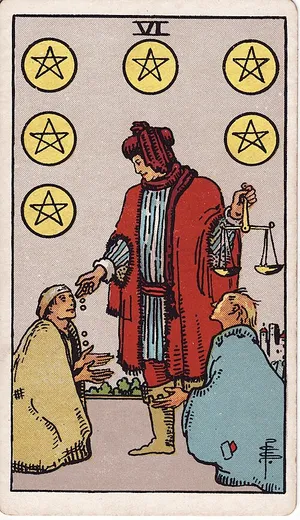

The Six of Pentacles is the sixth card of the suit of Pentacles, a numbered card among the 56 Minor Arcana of the Rider–Waite–Smith tarot, drawn by Pamela Colman Smith and published in London in 1909. A richly dressed man holds a pair of scales in one hand and drops coins with the other into the hands of a kneeling beggar, while a second figure kneels on his other side. Upright, it is usually read as giving and receiving, generosity and fair sharing; reversed, as giving with strings attached, or as Waite’s “Desire, cupidity, envy, jealousy, illusion”.
Key facts
- Suit: Pentacles, which many readers today connect with money, work and material exchange. Today’s common pairing gives the suit the element Earth; other schools pair it differently, as the tarot glossary notes.
- Rank: Six, a numbered card, between the Five and the Seven of Pentacles. The Roman numeral VI is printed at the top.
- Upright in one line: generosity, help given and received, a fair share.
- Reversed in one line: an uneven exchange; giving that buys power, or wanting what others have.
- Waite’s own key words (1910, shortened): “Presents, gifts, gratification”; also “attention, vigilance”; reversed, “Desire, cupidity, envy, jealousy, illusion”.
What the picture shows
Six yellow pentacles fill the upper part of the card against a plain grey sky: three in a row along the top, two below them at the sides, and one more lower down on the left. Under them stands the giver. He wears a soft red hat wound high on his head, a long red cloak with dark edges, a tunic striped in blue and grey with a red sash, and pale boots. His face is in profile, looking down to the left.
In his left hand he holds up a pair of scales; the two pans hang level. With his right hand he lets a few small coins fall into the cupped hands of a kneeling figure on the left, who wears a patched yellow-brown cloak and a cloth tied round the head and looks up at him. On the right kneels a second figure in a blue cloak with a small red and white patch on it. He has fair hair, looks up at the giver and stretches out his hands, but nothing is falling into them.
Behind the group runs a low strip of green bushes, and at the right edge a few towers of a town can be seen. The ground is grey and bare. Smith’s monogram is in the lower right corner.
Waite’s note reads the man kindly: he is “A person in the guise of a merchant”, who “weighs money in a pair of scales and distributes it to the needy and distressed”, and the scene “is a testimony to his own success in life, as well as to his goodness of heart”. In the picture the giver stands while the two others kneel, and only one of them is receiving coins at this moment. Waite does not use this to question the giver’s motives; his note is wholly approving.
Waite’s meanings in 1910
In Part III, §2 of The Pictorial Key to the Tarot, Waite gives the divinatory meanings for the Six of Pentacles:
“Presents, gifts, gratification; another account says attention, vigilance; now is the accepted time, present prosperity, etc. Reversed: Desire, cupidity, envy, jealousy, illusion.”
The upright line is generous, but it holds a second account: “attention, vigilance”, followed by “now is the accepted time”. That phrase echoes the King James Bible, 2 Corinthians 6:2, “behold, now is the accepted time”, and here it seems to mean that the moment is favourable. The “etc.” is Waite’s own: he does not finish the list. The reversed line turns from giving to wanting: “Desire, cupidity, envy, jealousy, illusion”.
Part III, §4, “Some Additional Meanings of the Lesser Arcana”, is a further set of meanings Waite lists, and for this card it pulls the other way:
“Six.—The present must not be relied on. Reversed: A check on the Querent’s ambition.”
Against “present prosperity” in §2, the §4 line says “The present must not be relied on”. Waite admits that the additional meanings are “very often in disagreement with those previously given”, and this card is a clear case. Both are period fortune-telling formulas, kept here as history; neither says anything about the reader.
How the card is usually read today
One common modern reading takes the Six of Pentacles as a card about the balance of giving and receiving: who has, who needs, and how the sharing is measured. In that reading it can describe generosity and support on either side of the exchange, and it can also ask what the exchange does to the people in it. Treat it as a question for reflection, not as a forecast.
Upright. Readers often connect it with generosity, charity, sharing resources, help that arrives when it is needed, or a fair settlement. Some read the scales as care in giving: enough to help, measured so the giver can keep going.
Reversed. Waite’s “Desire, cupidity, envy, jealousy, illusion” points to wanting rather than giving. Later readings often add generosity with strings attached, debts that create dependence, giving to stay in control, or always being the one who gives, or always the one who asks.
Questions people often take from the card:
- In this situation, am I mostly giving or mostly receiving, and how does that feel?
- Is what I give, or receive, offered freely or with conditions?
- Who in this picture have I not noticed yet?
Upright and reversed at a glance
| Upright | Reversed | |
|---|---|---|
| Waite, 1910 | Presents, gifts, gratification; attention, vigilance; present prosperity | Desire, cupidity, envy, jealousy, illusion |
| Common reading today | Generosity; giving and receiving; fair sharing | Strings attached; uneven power; envy |
| A question to ask | How is this being shared, and by whom? | What does this exchange cost the people in it? |
The Six of Pentacles in a spread
- Three cards (Past, Present, Future). In the Past position, it can point to help you gave or received that still shapes a relationship. In the Present, it asks how resources, time or care are being shared at the moment. In the Future position, readers usually take it as an invitation to think about what you are able to offer or willing to ask for, not as a promise of help or gain.
- Celtic cross. In the Hopes position, it can invite you to look at what kind of support you are hoping to give or to receive. In the Outcome position, many readers look at the cards around it to see whether the exchange they describe is even-handed or one-sided.
The positions of both spreads and the names of all 78 cards are in the tarot glossary; where the deck and its pictures come from is in the 1909 Rider–Waite–Smith tarot.
Cards often read next to the Six of Pentacles
- Five of Pentacles, the card before it: “Two mendicants in a snow-storm”, in Waite’s entry for it; the need that the Six answers.
- Seven of Pentacles, the card after it: a young man leaning on his staff and looking at what he has grown; from sharing to waiting on one’s own work.
- Six of Cups: in Waite’s entry for it, “Children in an old garden, their cups filled with flowers”; another gift, given out of memory and affection rather than means.
In HeyFate, each card you draw is turned upright or reversed at random with even odds, and an AI model writes the reading. This page is the reference behind the card, not a reading of your own question.
Sources
- A. E. Waite, The Pictorial Key to the Tarot, Part III, §2, “The Suit of Pentacles: Six” (Wikisource, from the 1922 reprint)
- A. E. Waite, The Pictorial Key to the Tarot, Part III, §4, “Some Additional Meanings of the Lesser Arcana” (Wikisource, from the 1922 reprint)
- 2 Corinthians 6:2, King James Version (Wikisource)
- Wikimedia Commons: Pents06.jpg (Pam-A scan, public domain)
AI-generated content, for reference only; not medical, legal, financial or psychological advice. These methods come from cultural traditions, and HeyFate offers them for cultural interest, entertainment and self-reflection.