Five of Pentacles Tarot Card Meaning: Upright, Reversed and Symbolism
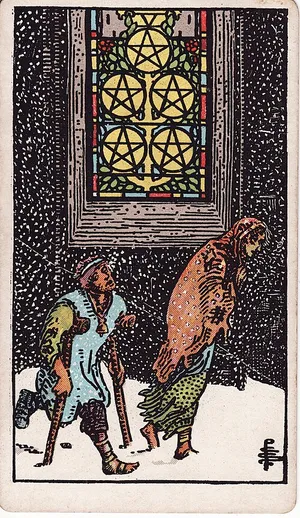

The Five of Pentacles is the fifth card of the suit of Pentacles, a numbered card among the 56 Minor Arcana of the Rider–Waite–Smith tarot, drawn by Pamela Colman Smith and published in London in 1909. Two poor figures, one on crutches, make their way through falling snow past a stained-glass window set with five pentacles. Upright, it is usually read as hardship, worry or feeling left out in the cold; reversed, as that hardship easing, or, in Waite’s list, as disorder and discord.
Key facts
- Suit: Pentacles, which many readers today connect with money, work, the body and material security. Today’s common pairing gives the suit the element Earth; other schools differ, as the 1909 Rider–Waite–Smith tarot explains.
- Rank: Five, a numbered card, between the Four and the Six of Pentacles. On this scan no separate numeral can be made out at the top; the window runs right up to the top edge.
- Upright in one line: hard times, exclusion, the feeling of being out in the cold.
- Reversed in one line: the cold beginning to lift, or, in Waite’s list, disorder and discord.
- Waite’s own key words (1910, shortened): “material trouble above all”, “destitution”; or, “For some cartomancists”, love and lovers; reversed, “Disorder, chaos, ruin, discord, profligacy”.
What the picture shows
The background is a dark wall, almost black, flecked all over with white snow. High in it is a tall window of coloured glass in a heavy grey stone frame with a deep sill. Five yellow pentacles are set in the glass, one at the top and two pairs below, strung on a branching yellow stem among green leaves, with a small red flower in each upper corner and a border of red, blue and yellow panes. The window is the brightest thing on the card; Waite calls it “a lighted casement”.
Below, the ground is deep in snow. On the left a figure leans on two wooden crutches, one leg bent back and lifted off the ground, its foot wrapped in dark cloth; the other foot is bound in rags. His head is tied with a pinkish cloth and his pale blue tunic is ragged. On a cord at his chest hangs something that looks like a small bell. He lifts his face, looking up and to the right.
The second figure walks ahead to the right, hunched, head bowed, wrapped from head to knees in a dotted orange shawl over a green skirt, the feet bare in the snow. Waite’s note calls them simply “Two mendicants” and gives them no names or genders. Neither of them is shown turning towards the window. Smith’s monogram is in the lower right corner.
The picture shows a lit window and two people passing it; whether help is on offer inside is not something the card or Waite says.
Waite’s meanings in 1910
In Part III, §2 of The Pictorial Key to the Tarot, Waite’s note is a single line, “Two mendicants in a snow-storm pass a lighted casement.” The divinatory meanings follow:
“The card foretells material trouble above all, whether in the form illustrated—that is, destitution—or otherwise. For some cartomancists, it is a card of love and lovers—wife, husband, friend, mistress; also concordance, affinities. These alternatives cannot be harmonized. Reversed: Disorder, chaos, ruin, discord, profligacy.”
These are the words of a 1910 fortune-telling handbook, quoted as history; they are not a statement about anyone who draws the card today. What stands out is Waite’s honesty about the sources. His main reading is material trouble; “some cartomancists” saw love and affinity instead, and he does not try to reconcile the two: “These alternatives cannot be harmonized.”
At the start of §2 Waite promised “a harmony of their meanings … from all sources”; on this card he admits he cannot produce one. Part III, §4, “Some Additional Meanings of the Lesser Arcana”, is a further set of meanings Waite lists, and for this card it adds yet another:
“Five.—Conquest of fortune by reason. Reversed: Troubles in love.”
That brings a third direction, almost the opposite of the first. Waite notes after the list that these additional meanings are “very often in disagreement with those previously given”, and the Five of Pentacles shows it clearly. All of these lines are period formulas, kept as history.
How the card is usually read today
One common modern reading starts from the picture: two people struggling through the cold, past a lit window. In that reading the card is about hardship and about feeling shut out, whether by lack of money, by loneliness or by pride, and often about help that is nearer than it seems. It is a prompt for reflection, not a forecast.
Upright. Readers often connect it with financial strain, worry, feeling excluded or left behind, or going through a hard time alongside someone else. Some point out that the two figures are together: whatever they lack, they are not alone.
Reversed. Waite’s reversed list is darker, “Disorder, chaos, ruin, discord, profligacy”. Many later readings go the other way and take the reversed card as hard times beginning to ease, accepting help, or finding a way back in from the cold. Some keep it closer to the upright: a strain that has gone on so long it has become ordinary.
Questions people often take from the card:
- Where do I feel left out in the cold, and is that only about money?
- Is there help near me that I have not asked for or noticed?
- Who is going through this with me, and what do we need from each other?
Upright and reversed at a glance
| Upright | Reversed | |
|---|---|---|
| Waite, 1910 | Material trouble, destitution; or love and affinities | Disorder, chaos, ruin, discord, profligacy |
| Common reading today | Hardship; worry; feeling shut out | Hard times easing; accepting help |
| A question to ask | What would it take to knock on the door? | What has helped me come in from the cold? |
The Five of Pentacles in a spread
- Three cards (Past, Present, Future). In the Past position, it can recall a hard period whose lessons or fears are still with you. In the Present, it asks where you feel under strain and whether you are carrying it alone. In the Future position, readers usually take it as an invitation to think about what support you might want to line up, not as a fixed event.
- Celtic cross. In the Challenge position, it can invite reflection on a strain, material or otherwise, that needs facing directly. In the Environment position, it may point to the people and places around you, and whether any of them is the lit window you have walked past.
The positions of both spreads and the names of all 78 cards are in the tarot glossary; where the deck and its pictures come from is in the 1909 Rider–Waite–Smith tarot.
Cards often read next to the Five of Pentacles
- Four of Pentacles, the card before it: a crowned figure holding tightly to what he has; the Five is often read as the fear behind that grip.
- Six of Pentacles, the card after it: in Waite’s entry for it, a merchant who “distributes it to the needy and distressed”; a scene of assistance to compare with the hardship in the Five.
- Five of Cups: in Waite’s entry for it, “a card of loss, but something remains over”. Modern readings often stress loss of feeling or hope, though Waite’s entry also names “inheritance, patrimony, transmission”, so it does not leave out material things.
In HeyFate, each card you draw is turned upright or reversed at random with even odds, and an AI model writes the reading. This page is the reference behind the card, not a reading of your own question.
Sources
- A. E. Waite, The Pictorial Key to the Tarot, Part III, §2, “The Suit of Pentacles: Five” (Wikisource, from the 1922 reprint)
- A. E. Waite, The Pictorial Key to the Tarot, Part III, §4, “Some Additional Meanings of the Lesser Arcana” (Wikisource, from the 1922 reprint)
- Wikimedia Commons: Pents05.jpg (Pam-A scan, public domain)
AI-generated content, for reference only; not medical, legal, financial or psychological advice. These methods come from cultural traditions, and HeyFate offers them for cultural interest, entertainment and self-reflection.