Seven of Pentacles Tarot Card Meaning: Upright, Reversed and Symbolism
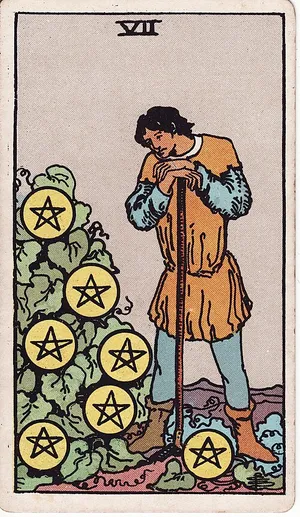

The Seven of Pentacles is the seventh card of the suit of Pentacles, a numbered card among the 56 Minor Arcana of the Rider–Waite–Smith tarot, drawn by Pamela Colman Smith and published in London in 1909. A young man leans with both hands on a long staff and looks at a leafy bush hung with pentacles, with one more pentacle on the ground at his feet. Upright, it is usually read as a pause to take stock of slow, patient work; reversed, as impatience, or worry that the effort is not paying off.
Key facts
- Suit: Pentacles, which many readers today connect with work, money, growth and the material world. Today’s common pairing gives the suit the element Earth; how the suits pair with elements differs between schools, as the 1909 Rider–Waite–Smith tarot sets out.
- Rank: Seven, a numbered card, between the Six and the Eight of Pentacles. The Roman numeral VII is printed at the top.
- Upright in one line: patience, assessment, waiting for work to bear fruit.
- Reversed in one line: impatience; worry about money or about whether the effort was worth it.
- Waite’s own key words (1910, shortened): “money, business, barter”; or “altercation, quarrel”; or “innocence, ingenuity, purgation”; reversed, “Cause for anxiety regarding money”.
What the picture shows
The young man stands on the right, turned towards the left of the card. He has dark hair, a white collar, an orange tunic falling to mid-thigh, full pale blue sleeves, blue hose and boots, one dark brown and one orange-brown. He holds a long, thin staff upright in front of him, both hands folded over its top, and bends his head towards his hands. His head tilts to one side, and he looks down towards the bush with a calm, tired or thoughtful face; the picture does not settle which.
On the left, filling almost half the card, is a dense mound of large green leaves with curling tendrils. Six yellow pentacles hang among the leaves, spread from top to bottom. A seventh lies on the ground at the young man’s feet, just beside the foot of his staff. The ground is reddish-purple earth, broken by small green tufts and blue-green patches, and a low line of purple hills runs behind him on the right. The sky is plain grey. Smith’s monogram is in the lower right corner.
Here the picture and Waite’s note differ slightly. Waite writes that the young man “looks intently at seven pentacles attached to a clump of greenery on his right”; in this scan six hang on the bush and one is on the ground. The bush is on the young man’s own right, as Waite says, which is the viewer’s left.
Waite’s meanings in 1910
Waite begins his entry in Part III, §2 of The Pictorial Key to the Tarot with the picture, adding that “one would say that these were his treasures and that his heart was there”. The words seem to echo Matthew 6:21 in the King James Bible, “For where your treasure is, there will your heart be also.” The divinatory meanings follow:
“These are exceedingly contradictory; in the main, it is a card of money, business, barter; but one reading gives altercation, quarrel—and another innocence, ingenuity, purgation. Reversed: Cause for anxiety regarding money which it may be proposed to lend.”
Waite opens by warning that the meanings are “exceedingly contradictory”, and he gives three in a row: money and trade, a quarrel, and “innocence, ingenuity, purgation”. In older usage “ingenuity” could also mean ingenuousness, that is frankness or candour, which sits more easily beside “innocence” than the modern sense of cleverness. The reversed meaning is unusually specific: anxiety about money that someone is thinking of lending.
Part III, §4, “Some Additional Meanings of the Lesser Arcana”, is a further set of meanings Waite lists, which he says are “very often in disagreement with those previously given”:
“Seven.—Improved position for a lady’s future husband. Reversed: Impatience, apprehension, suspicion.”
The upright line is a fortune-teller’s formula about a woman’s marriage prospects, plainly of its time; it is kept here as history and says nothing about the reader. The reversed line, “Impatience, apprehension, suspicion”, is closer to how the card is often read now.
How the card is usually read today
One common modern reading takes the picture at face value: someone who has worked hard on something that grows slowly stops to lean on his tool and look at it. In that reading the card is about patience and assessment, about checking whether the effort is going where you hoped, and about the gap between sowing and harvest. Use it to reflect on your own situation; it does not tell you what will come.
Upright. Readers often connect it with long-term projects, steady investment of time or money, a pause to review progress, or deciding whether to keep going in the same direction. Some point to the posture: he is resting, not giving up.
Reversed. Waite gives “Cause for anxiety regarding money which it may be proposed to lend”, and his §4 list gives “Impatience, apprehension, suspicion”. Later readings often add frustration with slow results, effort that seems wasted, or the urge to give up before the work has had time to grow.
Questions people often take from the card:
- What have I been tending for a long time, and what has it grown into so far?
- Am I pausing to take stock, or waiting for something to happen by itself?
- If I could only keep one part of this work, which would it be?
Upright and reversed at a glance
| Upright | Reversed | |
|---|---|---|
| Waite, 1910 | Money, business, barter; or quarrel; or innocence, ingenuity, purgation | Cause for anxiety about money it may be proposed to lend |
| Common reading today | Patience; taking stock; long-term work | Impatience; worry that the effort is not paying off |
| A question to ask | What is this work actually growing? | What am I rushing that needs more time? |
The Seven of Pentacles in a spread
- Three cards (Past, Present, Future). In the Past position, it can point to effort put in long ago that is still shaping things now. In the Present, it asks you to look honestly at how a project or commitment is going. In the Future position, readers usually take it as a prompt to think about what you are willing to wait for, not as a promise of a harvest.
- Celtic cross. In the Crown position, it can invite you to name the long-term aim behind your present work. In the Future position, it may suggest a point where you stop and review, and a question about what you would do then.
The positions of both spreads and the names of all 78 cards are in the tarot glossary; where the deck and its pictures come from is in the 1909 Rider–Waite–Smith tarot.
Cards often read next to the Seven of Pentacles
- Six of Pentacles, the card before it: a merchant sharing out coins with a pair of scales; from giving to watching the pentacles among the leaves.
- Eight of Pentacles, the card after it: in Waite’s entry for it, “An artist in stone at his work”; the pause of the Seven gives way to steady work at the bench.
- Seven of Wands: in Waite’s entry for it, “A young man on a craggy eminence brandishing a staff”; another young man with a staff, but defending his ground instead of waiting on it.
In HeyFate, each card you draw is turned upright or reversed at random with even odds, and an AI model writes the reading. This page is the reference behind the card, not a reading of your own question.
Sources
- A. E. Waite, The Pictorial Key to the Tarot, Part III, §2, “The Suit of Pentacles: Seven” (Wikisource, from the 1922 reprint)
- A. E. Waite, The Pictorial Key to the Tarot, Part III, §4, “Some Additional Meanings of the Lesser Arcana” (Wikisource, from the 1922 reprint)
- Matthew 6:21, King James Version (Wikisource)
- Wikimedia Commons: Pents07.jpg (Pam-A scan, public domain)
AI-generated content, for reference only; not medical, legal, financial or psychological advice. These methods come from cultural traditions, and HeyFate offers them for cultural interest, entertainment and self-reflection.