Seven of Wands Tarot Card Meaning: Upright, Reversed and Symbolism
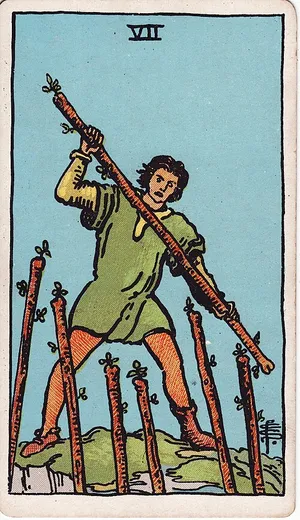

The Seven of Wands is the seventh card of the suit of Wands, one of the four suits of 14 cards that make up the 56 Minor Arcana in the Rider–Waite–Smith tarot, drawn by Pamela Colman Smith and published in London in 1909. It shows a young man on a grassy height, gripping a staff across his body while six other staves rise towards him from below. Upright, it is usually read as standing your ground under pressure; reversed, as feeling overwhelmed, worn down or unable to decide.
Key facts
- Suit: Wands, often linked today with energy, drive, ambition and creative work. Fire is today’s common pairing for the suit, but schools differ; see the tarot glossary and the 1909 Rider–Waite–Smith tarot.
- Rank: a numbered card, the Seven, marked only with the Roman numeral VII at the top.
- Upright in one line: holding a position, defending what you believe, persistence against odds.
- Reversed in one line: being worn down, defensiveness, hesitation about whether to hold on.
- Waite’s own key words (1910, abridged): valour, the vantage position, discussion, “wordy strife”, competition, success; reversed, perplexity, embarrassments, anxiety, “a caution against indecision”.
What the picture shows
The young man fills the upper half of the card against a plain blue sky. He wears a green tunic over yellow sleeves, and his legs, in orange-red hose, are planted wide apart on a green mound. He holds his staff in both hands, slanting from high on the left down to the right, one arm raised high; it looks as much like a guard as a strike. His dark hair is tousled, and he looks down and to the left.
Six staves come up at him from below the edge of the mound, standing at different heights, each with small leaves. Nobody holding them is visible: the attackers are present only as their staves. Below the mound, the lower left corner shows grey rock. Waite’s note: “A young man on a craggy eminence brandishing a staff; six other staves are raised towards him from below.” Smith’s monogram is at the lower right.
One detail is easy to miss. His feet do not match: the foot on the left wears a low shoe, the one on the right a taller boot. Waite does not mention it in his note, and this page does not read a meaning into it.
Waite’s meanings in 1910
In Part III, §2 of The Pictorial Key to the Tarot, Waite gives the divinatory meanings for the Seven of Wands:
“It is a card of valour, for, on the surface, six are attacking one, who has, however, the vantage position. On the intellectual plane, it signifies discussion, wordy strife; in business—negotiations, war of trade, barter, competition. It is further a card of success, for the combatant is on the top and his enemies may be unable to reach him. Reversed: Perplexity, embarrassments, anxiety. It is also a caution against indecision.”
Waite reads the picture literally and then moves it onto other planes. Six against one would usually be a losing fight, but the one holds the higher ground, so the card is valour and even “success”. On “the intellectual plane” the same scene becomes argument, and in business it becomes negotiation and trade rivalry. The reversed meanings turn the courage inward into confusion, and he adds a plain warning: “a caution against indecision”.
Section 4, “Some Additional Meanings of the Lesser Arcana”, is a further set of meanings Waite lists for each card; after the list he notes that they “are very often in disagreement with those previously given”. They are period fortune-telling formulas, kept here as history, not as anything about the reader. For this card the entry is three words:
“A dark child.”
Waite gives no explanation. In §7, “An Ancient Celtic Method of Divination”, he uses “dark” for hair and complexion when matching court cards to people, so the phrase probably describes appearance; it is quoted here only as part of the record.
How the card is usually read today
One common modern reading treats the Seven of Wands as holding a position once it has been won: after the triumph of the Six, the winner has to defend the place. In that reading the card is about conviction under pressure, and about whether the ground you stand on is worth the effort. Take it as a prompt for reflection, not a forecast.
Upright. Readers often connect it with standing up for a belief, protecting a boundary, competition at work, or persistence when many voices push back. Waite’s “wordy strife” leads some readers to read it as a debate as much as a fight.
Reversed. Waite gives “Perplexity, embarrassments, anxiety” and “a caution against indecision”. Later readings often take the reversed Seven as being worn down: feeling outnumbered, defending everything at once, giving ground, or wondering whether the position is still worth holding. Some read it the other way, as defensiveness that sees attacks where there are none.
Questions people often take from the card:
- What am I defending here, and is it still worth it to me?
- Which of these pressures need an answer, and which can I let pass?
- Am I holding my ground, or simply unable to decide whether to move?
Upright and reversed at a glance
| Upright | Reversed | |
|---|---|---|
| Waite, 1910 | Valour; the vantage position; discussion, wordy strife; competition; success | Perplexity, embarrassments, anxiety; a caution against indecision |
| Common reading today | Standing your ground, conviction under pressure | Being worn down, defensiveness, hesitation |
| A question to ask | What is worth defending here? | What would I let go if I stopped fighting everything? |
The Seven of Wands in a spread
Each position gives the card a slightly different question.
- Three cards (Past, Present, Future). In the Past position, it can point to a time when you had to hold your ground, and what it taught you. In the Present, it asks what you are defending now and against whom. In the Future position, readers usually take it as an invitation to decide which positions matter to you, not as a sign that a conflict is coming.
- Celtic cross. In the Challenge position, it can point to pressure from several sides at once. In the Self position, it may ask how you behave when you feel outnumbered. In the Crown position, it can ask what you are aiming to protect or keep.
The positions of both spreads and the names of all 78 cards are in the tarot glossary; where the deck and its pictures come from is in the 1909 Rider–Waite–Smith tarot.
Cards often read next to the Seven of Wands
- Six of Wands, the card before it: a laurelled rider in procession; the win that now has to be held.
- Eight of Wands, the card after it: in Waite’s Part III, §2 entry for the Eight of Wands, “a flight of wands through an open country”; eight staves in the air with no figure at all, instead of six raised against one man.
- Seven of Swords: in Waite’s Part III, §2 entry for the Seven of Swords, “A man in the act of carrying away five swords rapidly”; a lone figure again, with the two remaining swords “stuck in the ground”, but acting by stealth rather than in open defence.
- Seven of Pentacles: in Waite’s Part III, §2 entry for the Seven of Pentacles, “A young man, leaning on his staff, looks intently at seven pentacles”; a pause to assess rather than a stand.
In HeyFate, each card you draw is turned upright or reversed at random with even odds, and an AI model writes the reading. This page is the reference behind the card, not a reading of your own question.
Sources
- A. E. Waite, The Pictorial Key to the Tarot, Part III, §2, “The Suit of Wands: Seven”, with lines from “Wands: Eight” and the Sevens of Swords and Pentacles (Wikisource, from the 1922 reprint)
- A. E. Waite, The Pictorial Key to the Tarot, Part III, §4, “Some Additional Meanings of the Lesser Arcana”, and §7, “An Ancient Celtic Method of Divination” (Wikisource, from the 1922 reprint)
- Wikimedia Commons: Wands07.jpg (Pam-A scan, public domain)
AI-generated content, for reference only; not medical, legal, financial or psychological advice. These methods come from cultural traditions, and HeyFate offers them for cultural interest, entertainment and self-reflection.