Five of Wands Tarot Card Meaning: Upright, Reversed and Symbolism
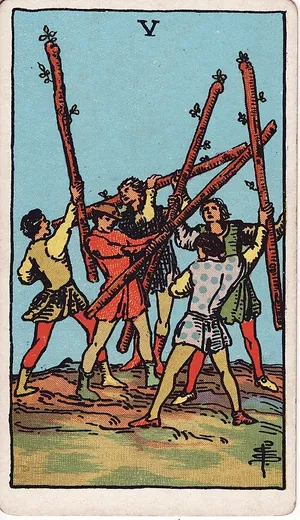

The Five of Wands is the fifth card of the suit of Wands, one of the four suits of 14 cards that make up the 56 Minor Arcana in the Rider–Waite–Smith tarot, drawn by Pamela Colman Smith and published in London in 1909. It shows five young men brandishing staves that cross in a tangle above their heads, as if in a game or a scuffle. Upright, it is usually read as competition, friction and clashing ideas; reversed, as conflict avoided, winding down, or turning into something more serious.
Key facts
- Suit: Wands, often linked today with energy, drive, ambition and creative work. Fire is today’s common pairing for the suit, but schools differ; see the tarot glossary and the 1909 Rider–Waite–Smith tarot.
- Rank: a numbered card, the Five, marked only with the Roman numeral V at the top.
- Upright in one line: rivalry, a lively contest, many voices pulling different ways.
- Reversed in one line: tension sidestepped or easing; or disagreement hardening into dispute.
- Waite’s own key words (1910, abridged): imitation, sham fight, strenuous competition, “the battle of life”; reversed, litigation, disputes, trickery, contradiction.
What the picture shows
Against a plain blue sky, five young men crowd together on rough brown and green ground, each holding a staff. The staves cross at every angle, most of them raised high, so that the eye sees a lattice of wood before it sees any single blow. Every staff carries small leaves.
The five are dressed differently. On the left, one in a yellow-green tunic and red hose has his back half turned to us. Next to him, a youth in a red tunic and a brown hat leans in. Behind them stands a taller figure in a dark, patterned tunic with yellow sleeves, his face tipped upwards. On the right, one in a green tunic and red hose holds his staff upright. In front, seen from behind, a youth in a white tunic with blue spots braces his legs apart. The picture does not show anyone being hit.
Waite’s note: “A posse of youths, who are brandishing staves, as if in sport or strife. It is mimic warfare”. He first describes the action as “as if in sport or strife”, then settles it at once: it is “mimic warfare”, a fight in play rather than in earnest. Smith’s monogram is at the lower right.
Waite’s meanings in 1910
In Part III, §2 of The Pictorial Key to the Tarot, Waite runs straight from the picture into the divinatory meanings (“hereto correspond the Divinatory Meanings”):
“Imitation, as, for example, sham fight, but also the strenuous competition and struggle of the search after riches and fortune. In this sense it connects with the battle of life. Hence some attributions say that it is a card of gold, gain, opulence. Reversed: Litigation, disputes, trickery, contradiction.”
Waite’s chain of reasoning is visible here. The fight is a sham, an imitation; but a sham fight stands for real competition, the struggle for wealth. Then comes the last step: “Hence some attributions say that it is a card of gold, gain, opulence.” He gives it to “some attributions” without saying whose they are or how old. Reversed, the play turns into real dispute: lawsuits, trickery, contradiction.
Section 4, “Some Additional Meanings of the Lesser Arcana”, is a further set of meanings Waite lists for each card; after the list he notes that they “are very often in disagreement with those previously given”. They are period fortune-telling formulas, kept here as history, not as anything about the reader. For this card:
“Success in financial speculation. Reversed: Quarrels may be turned to advantage.”
The money line follows from the “gold, gain, opulence” attribution in §2. It is quoted as a record of how the card was once used, not as advice about money.
How the card is usually read today
One common modern reading treats the Five of Wands as friction among equals: no one is winning, nobody seems hurt, and everybody is pushing. In that reading the card can describe rivalry and clashing egos, but also a noisy, energetic exchange of ideas, the kind of contest that sharpens people. Take it as a prompt for reflection, not a forecast.
Upright. Readers often connect it with competition at work or in a group, disagreements that have not settled, too many people trying to lead, or a struggle that is partly play. Some readers ask whether the contest is producing something or only noise.
Reversed. Waite gives “Litigation, disputes, trickery, contradiction”, a sharper conflict than the upright. Later readings vary: some take the reversed Five as conflict avoided or coming to an end, a truce or a cooling-off; others, closer to Waite, as friction that has turned bitter, or tension pushed out of sight rather than resolved.
Questions people often take from the card:
- Is this a contest I chose, or one I was pulled into?
- What is the disagreement really about, under the noise?
- Could this friction be useful, if it had some rules?
Upright and reversed at a glance
| Upright | Reversed | |
|---|---|---|
| Waite, 1910 | Imitation, sham fight; strenuous competition; the battle of life; by some, gold and gain | Litigation, disputes, trickery, contradiction |
| Common reading today | Competition, friction, clashing ideas | Conflict avoided or winding down; or hardening into dispute |
| A question to ask | What is this contest for? | Am I avoiding a disagreement, or deepening it? |
The Five of Wands in a spread
Each position asks the card something slightly different.
- Three cards (Past, Present, Future). In the Past position, it can point to a period of rivalry or argument that still colours things. In the Present, it asks where the friction is now and what it is costing. In the Future position, readers usually take it as an invitation to think about how you want to meet disagreement, not as a sign that a quarrel is coming.
- Celtic cross. In the Challenge position, it can point to competing pressures or people pulling in different directions. In the Environment position, it may describe a lively or crowded setting around the question. In the Outcome position, it can be set beside the cards around it, the Six of Wands for instance, to ask whether the contest is still running or has found a shape.
The positions of both spreads and the names of all 78 cards are in the tarot glossary; where the deck and its pictures come from is in the 1909 Rider–Waite–Smith tarot.
Cards often read next to the Five of Wands
- Four of Wands, the card before it: a garland between four staves; the peace before the scuffle.
- Six of Wands, the card after it: a laurelled rider among footmen; the contest now has a winner.
- Five of Swords: in Waite’s Part III, §2 entry for the Five of Swords, “A disdainful man looks after two retreating and dejected figures”; conflict with real losers, unlike this card’s mock battle.
- Five of Pentacles: in Waite’s Part III, §2 entry for the Five of Pentacles, “Two mendicants in a snow-storm pass a lighted casement”; struggle as hardship rather than contest.
In HeyFate, each card you draw is turned upright or reversed at random with even odds, and an AI model writes the reading. This page is the reference behind the card, not a reading of your own question.
Sources
- A. E. Waite, The Pictorial Key to the Tarot, Part III, §2, “The Suit of Wands: Five”, with lines from the Fives of Swords and Pentacles (Wikisource, from the 1922 reprint)
- A. E. Waite, The Pictorial Key to the Tarot, Part III, §4, “Some Additional Meanings of the Lesser Arcana” (Wikisource, from the 1922 reprint)
- Wikimedia Commons: Wands05.jpg (Pam-A scan, public domain)
AI-generated content, for reference only; not medical, legal, financial or psychological advice. These methods come from cultural traditions, and HeyFate offers them for cultural interest, entertainment and self-reflection.