Five of Swords Tarot Card Meaning: Upright, Reversed and Symbolism
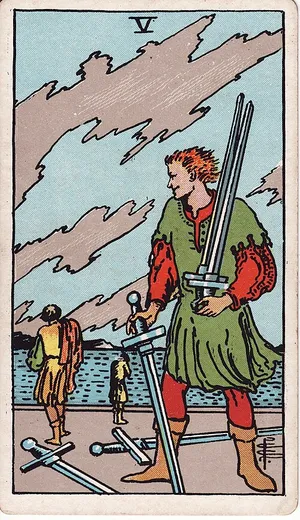

The Five of Swords is the fifth card of the suit of Swords, one of the four suits that make up the 56 Minor Arcana in the Rider–Waite–Smith tarot, drawn by Pamela Colman Smith and published in London in 1909. It shows a young man holding three swords and glancing after two figures who walk away towards the water, leaving two more swords on the ground. Upright, it is usually read as a conflict won at a cost, or a defeat that stings; reversed, as the wish to make peace, or a grudge that will not let go.
Key facts
- Suit: Swords, 14 cards. Readers today commonly associate the suit with thought, speech, decisions and conflict. Today’s common pairing is Air, but schools differ: Papus paired Swords with Earth, and Waite does not specify an element for Swords in this book (see the 1909 Rider–Waite–Smith tarot). In his entry for the Two of Swords, Waite warns that “Swords generally are not symbolical of beneficent forces in human affairs”.
- Rank: Five, a numbered card, with the Roman numeral V at the top and no title.
- Upright in one line: winning at a cost, humiliation, a fight that leaves everyone poorer.
- Reversed in one line: wanting to make amends, walking away, or resentment that lingers.
- Waite’s own key words (1910): degradation, destruction, revocation, infamy, dishonour, loss.
What the picture shows
A young man stands in the right foreground, the largest figure on the card. He has a shock of red-orange hair, a green tunic with red sleeves, red hose and tan boots. He is turned towards the viewer’s left, his head turned to watch the two figures walking away, the corner of his mouth turned up. In the hand on the viewer’s right he holds two swords upright, their blades rising past his shoulder. His other hand rests on the pommel of a third sword, whose point is on the ground.
Two more swords lie on the ground in the lower left foreground. Further off, two figures walk away towards the water with their backs to us. The nearer one wears a yellow tunic and carries a red cloak over one shoulder; the farther one, smaller, stands at the water’s edge with head bowed. Beyond them is a stretch of sea and a low, dark shore, and above, a pale blue sky torn by long, jagged grey clouds that streak across it on a slant. Smith’s monogram is at the lower right.
Waite’s note describes the scene closely: “A disdainful man looks after two retreating and dejected figures. Their swords lie upon the ground. He carries two others on his left shoulder, and a third sword is in his right hand, point to earth. He is the master in possession of the field.” His “left shoulder” is on the viewer’s right. Waite does not mention the clouds.
Waite’s meanings in 1910
In Part III, §2 of The Pictorial Key to the Tarot, Waite gives the divinatory meanings of the Five of Swords:
“Degradation, destruction, revocation, infamy, dishonour, loss, with the variants and analogues of these. Reversed: The same; burial and obsequies.”
The list centres on shame and loss, although Waite does not assign it to either side of the scene. The picture puts the winner in front: Waite calls him “the master in possession of the field”, the one left standing when the others have gone. Upright and reversed are almost the same; the reversed card only adds the rites of mourning, “burial and obsequies”. These are old cartomancy words, not a statement about anyone’s life or death.
In §4, “Some Additional Meanings of the Lesser Arcana”, Waite lists a further set of meanings, which he says are “very often in disagreement with those previously given”. For the Five:
“An attack on the fortune of the Querent. Reversed: A sign of sorrow and mourning.”
“Fortune” here means property or wealth. These are period fortune-telling formulas, kept here as history; they do not describe your situation.
How the card is usually read today
One common modern reading takes the Five of Swords as the card of the hollow victory. Someone has won the argument and collected the swords, but the others have walked off, and it is not clear what the win was worth. In that reading the card asks about the cost of conflict on both sides. Treat it as a prompt for reflection, not a forecast.
Upright. Readers often connect it with a fight where winning matters more than the relationship, sharp tactics, feeling humiliated after a defeat, or the urge to get the last word. Some also read it as knowing when a battle is not worth fighting, and choosing to walk away.
Reversed. Waite gives “The same”, with mourning added. Later readings more often take the reversed Five as the aftermath: wanting to make amends, putting down a grudge, or seeing a conflict differently once the heat has gone. Others read it as resentment that keeps the quarrel alive long after it ended.
Some questions to sit with:
- In this conflict, what would winning actually give me?
- Which part of this do I need to let go of, and which part do I need to stand up for?
- Is there someone I would rather have back than be right with?
Upright and reversed at a glance
| Upright | Reversed | |
|---|---|---|
| Waite, 1910 | Degradation, destruction, revocation, infamy, dishonour, loss | The same; burial and obsequies |
| Common reading today | A hollow victory; humiliation; conflict at a cost | Making amends; letting go; or a lingering grudge |
| A question to ask | What is this win costing? | What would it take to put the swords down? |
The Five of Swords in a spread
The card tends to ask who is standing where in a conflict, and what it is costing.
- Three cards (Past, Present, Future). In the Past position, it can point to an old quarrel whose effects are still felt. In the Present, it asks whether a disagreement has turned into a contest. In the Future position, readers usually take it as a prompt to weigh what a fight would cost before entering it, not as a fixed event.
- Celtic cross. In the Challenge position, it may point to pride, or a need to be right, that is getting in the way. In the Environment position, some readers see tension between other people that affects you. In the Outcome position, many readers look back at the Self card and ask which figure on this card it resembles.
The positions of both spreads and the names of all 78 cards are in the tarot glossary; where the deck and its pictures come from is in the 1909 Rider–Waite–Smith tarot.
Cards often read next to the Five of Swords
- Four of Swords, the card before it: swords laid down for rest. In the Five they are picked up again.
- Six of Swords, the card after it: a boat carrying passengers away across the water, often read as moving on from trouble.
- Five of Wands: the same rank in Wands, often read as struggle or competition, but more as a contest than as a wound.
- Five of Cups: the same rank in Cups, often read as grief over what has been lost, closer to the two figures walking away.
In HeyFate, each card you draw is turned upright or reversed at random with even odds, and an AI model writes the reading. This page is the reference behind the card, not a reading of your own question.
Sources
- A. E. Waite, The Pictorial Key to the Tarot, Part III, §2, “The Suit of Swords: Five”, with a short quotation from the entry for the Two of Swords (Wikisource, from the 1922 reprint)
- A. E. Waite, The Pictorial Key to the Tarot, Part III, §4, “Some Additional Meanings of the Lesser Arcana” (Wikisource, from the 1922 reprint)
- Wikimedia Commons: Swords05.jpg (Pam-A scan, public domain)
AI-generated content, for reference only; not medical, legal, financial or psychological advice. These methods come from cultural traditions, and HeyFate offers them for cultural interest, entertainment and self-reflection.