Four of Swords Tarot Card Meaning: Upright, Reversed and Symbolism
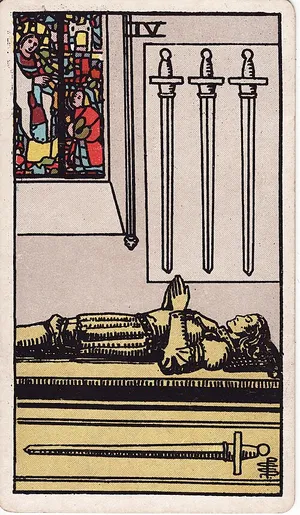

The Four of Swords is the fourth card of the suit of Swords, one of the four suits that make up the 56 Minor Arcana in the Rider–Waite–Smith tarot, drawn by Pamela Colman Smith and published in London in 1909. It shows the carved figure of a knight lying on a tomb with his hands joined in prayer, three swords hanging above him and a fourth along the side of the tomb. Upright, it is usually read as rest, retreat and recovery after strain; reversed, as restlessness, a return to activity, or rest that keeps being put off.
Key facts
- Suit: Swords, 14 cards. Readers today commonly associate the suit with thought, speech, decisions and conflict. Today’s common pairing is Air, but schools differ: Papus paired Swords with Earth, and Waite does not specify an element for Swords in this book (see the 1909 Rider–Waite–Smith tarot). In his entry for the Two of Swords, Waite warns that “Swords generally are not symbolical of beneficent forces in human affairs”.
- Rank: Four, a numbered card, with the Roman numeral IV at the top and no title.
- Upright in one line: rest, a pause, stepping back to recover.
- Reversed in one line: restlessness, coming back into motion, or rest denied.
- Waite’s own key words (1910): vigilance, retreat, solitude, “hermit’s repose”, exile; reversed, “Wise administration, circumspection, economy”.
What the picture shows
The scene is an interior. A tomb runs across the lower half of the card, and on its lid lies the full-length figure of a knight in armour, his head on the viewer’s right and his feet to the left. His eyes are closed and his hands are pressed together, palm to palm, pointing upwards from his chest. The knight and the tomb are coloured in the same yellowish ochre, so he reads as part of the monument, a carved effigy rather than a sleeping man. Waite’s note says just that: “The effigy of a knight in the attitude of prayer, at full length upon his tomb.”
Above him, three swords hang on the wall against a pale panel, side by side and points down. A fourth sword lies flat along the side of the tomb, its point to the viewer’s left and its hilt to the right, near Smith’s monogram.
In the upper left corner is a stained-glass window in red, yellow, blue and green. It shows two figures: a standing one at the top left, leaning over, with a hand reaching towards the head of a smaller figure in red who kneels below. Waite does not mention the window. The panel is too small to say more with confidence. The Roman numeral IV is at the top.
Waite’s meanings in 1910
In Part III, §2 of The Pictorial Key to the Tarot, Waite gives the divinatory meanings of the Four of Swords:
“Vigilance, retreat, solitude, hermit’s repose, exile, tomb and coffin. It is these last that have suggested the design. Reversed: Wise administration, circumspection, economy, avarice, precaution, testament.”
Here Waite says outright where the picture came from: the tomb on the card was drawn from the old meanings “tomb and coffin”. But the figure is an effigy at prayer, not a body, and the rest of his list is about withdrawal rather than death: watchfulness, retreat, solitude, the quiet of a hermit. The reversed list turns towards management and precaution: careful management, thrift, even “avarice”, and a “testament”, a will.
In §4, “Some Additional Meanings of the Lesser Arcana”, Waite lists a further set of meanings, noting that they are “very often in disagreement with those previously given”. For the Four:
“A bad card, but if reversed a qualified success may be expected by wise administration of affairs. Reversed: A certain success following wise administration.”
These are period fortune-telling formulas, kept here as history. The entry gives two formulations for the reversed card, a “qualified success” and “A certain success”; neither should be treated as a promise to the reader, and neither line says anything about what will happen to you.
How the card is usually read today
One common modern reading takes the Four of Swords as the suit’s resting point. After the hurt of the Three, the swords are put away, hung up or laid down, and the figure lies still. In that reading the card is about rest as something chosen and needed, not as defeat. Read it as a prompt for reflection, not as a forecast.
Upright. Readers often connect it with taking a break, stepping back from conflict, a period of quiet or reflection, or giving the mind time to settle before the next decision. Some take Waite’s “Vigilance” to mean that this rest is watchful, not careless.
Reversed. Waite’s reversed list is practical: careful management and prudence. Later readings more often take the reversed Four as restlessness, coming back into activity after a pause, or the strain of carrying on when rest is overdue. Some read it as a retreat that has gone on too long and become a way of hiding.
Questions people often take from the card:
- What would it mean to put this down for a while?
- Is my retreat restoring me, or only postponing something?
- What could I watch over quietly, rather than fight?
Upright and reversed at a glance
| Upright | Reversed | |
|---|---|---|
| Waite, 1910 | Vigilance, retreat, solitude, hermit’s repose, exile, tomb and coffin | Wise administration, circumspection, economy, avarice, precaution, testament |
| Common reading today | Rest, retreat, recovery, a pause | Restlessness; returning to activity; rest denied |
| A question to ask | What do I need to rest from? | What keeps me from stopping? |
The Four of Swords in a spread
In most positions, the card turns the question towards pace and recovery.
- Three cards (Past, Present, Future). In the Past position, it can point to a time of withdrawal that gave you room to think. In the Present, it asks whether you are getting the rest the situation needs. In the Future position, readers usually take it as an invitation to plan a pause before the next step, not as a fixed event.
- Celtic cross. In the Crown position, it may describe calm or clear thinking as the aim. In the Challenge position, it can point to inertia, or to a retreat that has become isolation. In the Self position, some readers ask whether you are allowing yourself to stop.
The positions of both spreads and the names of all 78 cards are in the tarot glossary; where the deck and its pictures come from is in the 1909 Rider–Waite–Smith tarot.
Cards often read next to the Four of Swords
- Three of Swords, the card before it: the pierced heart. The Four is often read as the rest that follows it.
- Five of Swords, the card after it: a fight won and lost, where the swords are picked up again.
- Four of Cups: the same rank in Cups, often read as withdrawal of a more discontented kind, turning away rather than resting.
- The Hermit (IX): Waite’s own “hermit’s repose” points to it; both are often read as solitude chosen for the sake of clarity.
In HeyFate, each card you draw is turned upright or reversed at random with even odds, and an AI model writes the reading. This page is the reference behind the card, not a reading of your own question.
Sources
- A. E. Waite, The Pictorial Key to the Tarot, Part III, §2, “The Suit of Swords: Four”, with a short quotation from the entry for the Two of Swords (Wikisource, from the 1922 reprint)
- A. E. Waite, The Pictorial Key to the Tarot, Part III, §4, “Some Additional Meanings of the Lesser Arcana” (Wikisource, from the 1922 reprint)
- Wikimedia Commons: Swords04.jpg (Pam-A scan, public domain)
AI-generated content, for reference only; not medical, legal, financial or psychological advice. These methods come from cultural traditions, and HeyFate offers them for cultural interest, entertainment and self-reflection.