Three of Swords Tarot Card Meaning: Upright, Reversed and Symbolism
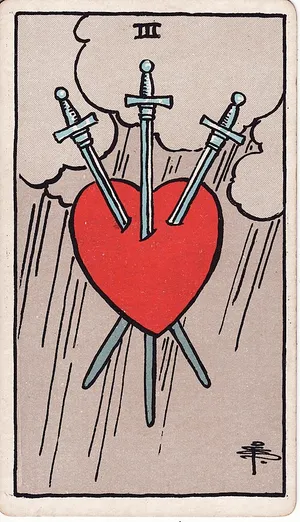

The Three of Swords is the third card of the suit of Swords, one of the four suits that make up the 56 Minor Arcana in the Rider–Waite–Smith tarot, drawn by Pamela Colman Smith and published in London in 1909. It shows a red heart pierced by three swords, with storm clouds and rain behind it. Upright, it is usually read as sorrow, a painful truth or a separation; reversed, as that pain easing, or as grief that has been pushed down and left unspoken.
Key facts
- Suit: Swords, 14 cards. Readers today commonly associate the suit with thought, speech, decisions and conflict. Today’s common pairing is Air, but schools differ: Papus paired Swords with Earth, and Waite does not specify an element for Swords in this book (see the 1909 Rider–Waite–Smith tarot). In his entry for the Two of Swords, Waite warns that “Swords generally are not symbolical of beneficent forces in human affairs”.
- Rank: Three, a numbered card, with the Roman numeral III at the top and no title.
- Upright in one line: grief, hurt, a truth that cuts.
- Reversed in one line: the hurt beginning to ease, or sorrow held in and not yet faced.
- Waite’s own key words (1910): removal, absence, delay, division, rupture, dispersion; reversed, error, loss, confusion.
What the picture shows
No person appears on this card. A large red heart fills the centre, outlined in black and drawn flat, like an emblem rather than an organ. Three swords pierce it. One drives straight down through the middle; the other two come in at an angle from the upper left and upper right. Their hilts, with round pommels and short crossguards, stand out above it, and their points come out underneath, spread a little apart.
Behind the heart, a heavy grey cloud fills the top of the card, and long slanting lines of rain fall from it across the whole grey background, down to the bottom edge. There is no ground, no horizon and no sky beyond the storm. The Roman numeral III sits at the top, and Smith’s monogram at the lower right.
Waite’s note matches the scan and is just as bare: “Three swords piercing a heart; cloud and rain behind.” He adds no symbolic reading of the heart or the weather.
Waite’s meanings in 1910
In Part III, §2 of The Pictorial Key to the Tarot, Waite gives the divinatory meanings of the Three of Swords:
“Removal, absence, delay, division, rupture, dispersion, and all that the design signifies naturally, being too simple and obvious to call for specific enumeration. Reversed: Mental alienation, error, loss, distraction, disorder, confusion.”
The words he gives are all about things being parted: removal, absence, division, rupture, dispersion. For the rest he points at the picture and says it speaks for itself. “Mental alienation”, in the reversed list, was a period term for a disturbed or deranged mind; it is quoted here as Waite’s word, not as anything about anyone’s health.
§4, “Some Additional Meanings of the Lesser Arcana”, is a further set of meanings Waite lists, and he warns that they are “very often in disagreement with those previously given”. For the Three:
“For a woman, the flight of her lover. Reversed: A meeting with one whom the Querent has compromised; also a nun.”
These are period fortune-telling formulas, kept here as history. The word “compromised” carries its old sense of a damaged reputation; the lines describe the stock situations of older cartomancy, not your own relationships.
How the card is usually read today
One common modern reading takes the Three of Swords as the card of heartache: grief, disappointment, a hurtful word, or a truth that is painful to hear. In that reading the card does not soften the pain, but it does not dwell on blame either; the rain falls and, in time, passes. Use it to reflect, not to forecast.
Upright. Readers often connect it with sorrow after a loss or a separation, words that wounded, a disappointment that needs to be admitted, or a hard truth finally said aloud. Some point out that naming the hurt is usually the start of dealing with it.
Reversed. Waite’s reversed list is about confusion and error. Later readings more often take the reversed Three as hurt that is easing, forgiveness beginning, or the slow work of recovery; others read it as grief that has been pushed down, kept busy over, or not yet allowed.
Questions people often take from the card:
- What has hurt me here that I have not yet said out loud?
- Is the pain coming from one place, or from several at once?
- What would help me get through the rain, rather than wait for it to stop?
Upright and reversed at a glance
| Upright | Reversed | |
|---|---|---|
| Waite, 1910 | Removal, absence, delay, division, rupture, dispersion | Mental alienation, error, loss, distraction, disorder, confusion |
| Common reading today | Heartache, grief, a painful truth | Hurt easing; recovery; or sorrow held in |
| A question to ask | What hurt needs to be named? | What am I not letting myself feel? |
The Three of Swords in a spread
The card is rarely gentle, but its position can show where the hurt sits.
- Three cards (Past, Present, Future). In the Past position, it can point to an old sorrow that still colours the question. In the Present, it asks what hurts now and whether that has been acknowledged. In the Future position, readers usually take it as a prompt to think about what difficult truth might need facing, not as a fixed event.
- Celtic cross. In the Root position, it may point to an earlier hurt underneath the whole situation. In the Past position, it can ask what that loss taught you. In the Environment position, some readers take it as tension or grief in the people around you, rather than in yourself.
The positions of both spreads and the names of all 78 cards are in the tarot glossary; where the deck and its pictures come from is in the 1909 Rider–Waite–Smith tarot.
Cards often read next to the Three of Swords
- Two of Swords, the card before it: a truth kept behind a blindfold. The Three is often read as the moment it lands.
- Four of Swords, the card after it: a still figure at rest, often read as the rest and recovery that follow hurt.
- Three of Cups: the same rank in the suit of Cups, often read as friendship and celebration, the opposite mood.
- Ten of Swords: often read as a painful ending in the same suit; the Three puts the weight on the hurt itself rather than on things being over.
In HeyFate, each card you draw is turned upright or reversed at random with even odds, and an AI model writes the reading. This page is the reference behind the card, not a reading of your own question.
Sources
- A. E. Waite, The Pictorial Key to the Tarot, Part III, §2, “The Suit of Swords: Three”, with a short quotation from the entry for the Two of Swords (Wikisource, from the 1922 reprint)
- A. E. Waite, The Pictorial Key to the Tarot, Part III, §4, “Some Additional Meanings of the Lesser Arcana” (Wikisource, from the 1922 reprint)
- Wikimedia Commons: Swords03.jpg (Pam-A scan, public domain)
AI-generated content, for reference only; not medical, legal, financial or psychological advice. These methods come from cultural traditions, and HeyFate offers them for cultural interest, entertainment and self-reflection.