Ten of Swords Tarot Card Meaning: Upright, Reversed and Symbolism
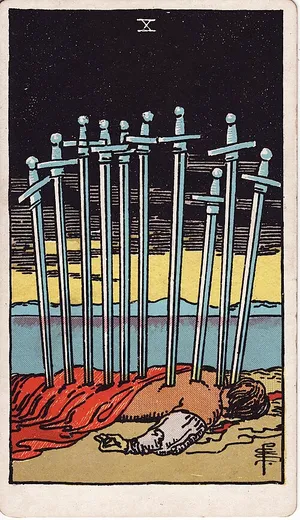

The Ten of Swords is the last numbered card in the suit of Swords, one of the four suits of 14 cards that make up the 56 Minor Arcana of the Rider–Waite–Smith tarot, drawn by Pamela Colman Smith and published in London in 1909. It shows a man lying face down by still water, ten swords standing in his back, under a black sky with a band of yellow light along the horizon. Upright, it is usually read as a painful ending, the low point of something that cannot go on; reversed, as slowly getting up again, or as refusing to let the ending happen.
Key facts
- Suit: Swords, a suit usually linked with thought, words, conflict and hard decisions. Today’s common pairing ties Swords to Air; the pairing is a convention that varies (Papus gave Swords to Earth), see the 1909 Rider–Waite–Smith tarot.
- Rank and place: the tenth and last numbered card of the suit, X at the top; it follows the Nine of Swords, and the Page of Swords comes next.
- Upright in one line: an ending that has fully arrived; exhaustion; the bottom of a hard run.
- Reversed in one line: recovery beginning, or holding on to what has already finished.
- Waite’s own key words (1910, selected): pain, affliction, tears, sadness, desolation; “not especially a card of violent death”.
What the picture shows
The upper half of the card is a black sky. Lower down, thin dark streaks of cloud give way to a broad band of yellow light just above a line of low blue hills. In front of the hills lies a wide strip of calm, pale blue water, and the foreground is flat, dull ochre ground.
On that ground a man lies face down, his head at the right, his brown hair towards us and his face hidden. A red cloth is spread over his lower body and spills across the ground to the left. Ten swords stand upright in him along the whole length of his body, from the red cloth over his legs to the back of his neck, their hilts making an uneven line against the dark sky. One arm, in a white sleeve, lies along the ground in front of him, and the hand at its end is open, with the fingers bent. Waite does not explain the hand. There is no other figure and nothing else in the landscape. The numeral X is at the top and Smith’s monogram is in the lower right corner.
Waite’s note is a single sentence: “A prostrate figure, pierced by all the swords belonging to the card.” The scan also shows the band of yellow light on the horizon under the black sky; Waite does not explain it.
Waite’s meanings in 1910
Waite opens §2 of Part III, on the Minor Arcana, with the promise that “a harmony of their meanings will be provided from all sources”. For the Ten of Swords he gives:
“Whatsoever is intimated by the design; also pain, affliction, tears, sadness, desolation. It is not especially a card of violent death. Reversed: Advantage, profit, success, favour, but none of these are permanent; also power and authority.”
Two lines in it are worth reading slowly. “It is not especially a card of violent death” is Waite’s own correction of the obvious reading of the picture: for all its swords, he explicitly limits a reading of the image as violent death. And the reversed meanings turn round completely, to “Advantage, profit, success, favour”, with a warning attached: “none of these are permanent”.
His §4, “Some Additional Meanings of the Lesser Arcana”, lists a further set of meanings, which he says are “very often in disagreement with those previously given”: “Followed by Ace and King, imprisonment; for girl or wife, treason on the part of friends. Reversed: Victory and consequent fortune for a soldier in war.” These are period formulas from cartomancy, with their combinations of cards and their soldiers and wives. They show how the card was used a century ago and are quoted here only as history.
How the card is usually read today
One common modern reading takes the Ten of Swords as rock bottom: something has ended, painfully and completely, and there is nothing left to defend. In that reading, the focus shifts from defending what has ended to considering what might come next. It is a prompt for reflection, not a forecast of harm.
Upright. Readers often connect it with the end of a job, a plan or a relationship, a betrayal, burnout, or the feeling of having been hit from every side at once.
Reversed. Waite’s reversed list is surprisingly hopeful, though he says its gains do not last. Later readings take the reversed card as recovery: getting up slowly, pulling the swords out one at a time, learning from what happened. Some also read it as resisting an ending, going back to a situation that is already over.
Questions to sit with:
- What in my situation has already ended, even if I have not accepted it?
- Am I treating one setback as if it were ten?
- What would getting up look like, one small step at a time?
Upright and reversed at a glance
| Upright | Reversed | |
|---|---|---|
| Waite, 1910 | Pain, affliction, tears, sadness, desolation; not especially violent death | Advantage, profit, success, favour, none of them permanent; power and authority |
| Common reading today | A painful ending; rock bottom; exhaustion | Slow recovery; or holding on to what has ended |
| A question to ask | What is truly over here? | What is the first step in getting up? |
The Ten of Swords in a spread
Because it marks an ending, its position mainly shows where in the story the ending falls.
- Three cards (Past, Present, Future). In the Past position, it can invite a look at a hard ending you have come through and what it still teaches. In the Present, it asks what has reached its end and whether you are still fighting for it. In the Future position, readers usually take it as a prompt to ask what you are ready to let finish, not as a fixed event.
- Celtic cross. In the Root position, it can point to an old hurt underneath the current matter. In the Past position, it may mark the low point the rest of the spread is moving away from. In the Outcome position, many readers look at the cards beside it for what can begin once this is over.
The positions of both spreads and the names of all 78 cards are in the tarot glossary; where the deck and its pictures come from is in the 1909 Rider–Waite–Smith tarot.
Cards often read next to the Ten of Swords
- Nine of Swords, the card before it: worry at night, with the swords still on the wall; in the Ten they have landed.
- Page of Swords, the next card in the suit: a young figure on his feet with a single sword raised, often read as starting again with a clear head.
- Ten of Wands: the same rank in Wands, “A man oppressed by the weight of the ten staves which he is carrying”; a burden still being carried, set against one that has come down.
- Ten of Cups: in Waite’s words, the “Appearance of Cups in a rainbow” over a family; the suit of feelings ends in fullness where Swords end in collapse.
In HeyFate, each card you draw is turned upright or reversed at random with even odds, and an AI model writes the reading. This page is the reference behind the card, not a reading of your own question.
Sources
- A. E. Waite, The Pictorial Key to the Tarot, Part III, §2, “The Suit of Swords: Ten”, also citing the Ten of Wands and Ten of Cups (Wikisource, from the 1922 reprint)
- A. E. Waite, The Pictorial Key to the Tarot, Part III, §4, “Some Additional Meanings of the Lesser Arcana” (Wikisource, from the 1922 reprint)
- Wikimedia Commons: Swords10.jpg (Pam-A scan, public domain)
AI-generated content, for reference only; not medical, legal, financial or psychological advice. These methods come from cultural traditions, and HeyFate offers them for cultural interest, entertainment and self-reflection.