Two of Cups Tarot Card Meaning: Upright, Reversed and Symbolism
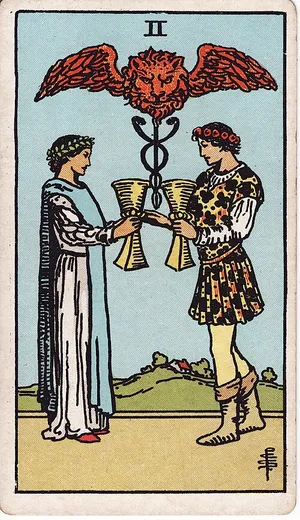

The Two of Cups is the second card of the suit of Cups, one of the four suits of the 56 Minor Arcana in the Rider–Waite–Smith tarot, drawn by Pamela Colman Smith and published in London in 1909. It shows two people facing each other, each holding up a cup, with a staff twined by two snakes between them and a winged lion’s head above. Upright, it is usually read as a meeting of two people on equal terms: affection, partnership or a sincere agreement; reversed, as that balance strained, with misunderstanding or one side giving more than the other.
Key facts
- Suit: Cups, the suit usually linked with feelings, relationships and the inner life. Today’s common pairing gives Cups the element of Water; schools differ on the pairings, as the tarot glossary and the 1909 Rider–Waite–Smith tarot explain.
- Rank: Two, the first of the numbered cards after the Ace. The card carries only the Roman numeral II.
- Upright in one line: mutual attraction, friendship, a bond or pact between two.
- Reversed in one line: an imbalance between two people, a rift, or a feeling not returned in the same measure.
- Waite’s own key words (1910): love, passion, friendship, affinity, union, concord, sympathy. His §2 entry gives no reversed meaning; the §4 list gives “Passion”.
What the picture shows
A Roman numeral II sits at the top against a pale blue sky. Two figures stand on level, pale yellow ground and face each other, each holding a golden cup. Waite describes them as “A youth and maiden” who “are pledging one another”.
The figure on the left wears a long white gown with a pale blue mantle that falls from the shoulders to the ground, a wreath of green leaves and red shoes. The figure on the right wears a wreath of red flowers, a short tunic patterned with dark trefoil-like shapes and red flecks on yellow, white sleeves, yellow hose and soft boots folded down at the top. Both hold their cups at chest height. The right-hand figure’s free hand reaches across towards the other’s cup, so the two hands nearly meet between them.
Rising from between the cups is a dark staff with two snakes coiled around it, and above it hovers a red lion’s head with a pair of large red wings. Waite: “above their cups rises the Caduceus of Hermes, between the great wings of which there appears a lion’s head.” Behind the figures, green hills roll away with a few trees and a small house with a red roof. Smith’s monogram is at the lower right.
Waite adds that the lion’s head and caduceus are “a variant of a sign which is found in a few old examples of this card”, and that “Some curious emblematical meanings are attached to it, but they do not concern us in this place.” He leaves the symbol unexplained here.
Waite’s meanings in 1910
From Part III, §2, of The Pictorial Key to the Tarot:
“Divinatory Meanings: Love, passion, friendship, affinity, union, concord, sympathy, the interrelation of the sexes, and—as a suggestion apart from all offices of divination—that desire which is not in Nature, but by which Nature is sanctified.”
The list moves from ordinary words of attachment to a last clause that Waite himself marks off from fortune-telling: a “desire which is not in Nature, but by which Nature is sanctified”. He does not expand on it, but it shows he saw more in this card than a simple love match.
This is also the one card in Waite’s entries for the 56 Minor Arcana whose §2 entry has no “Reversed” at all. A reversed meaning appears only in §4, “Some Additional Meanings of the Lesser Arcana”, a further set of meanings Waite lists for each card:
“Two.—Favourable in things of pleasure and business, as well as love; also wealth and honour. Reversed: Passion.”
Waite notes after the §4 list that these meanings “are very often in disagreement with those previously given”. They are period fortune-telling formulas, kept here as history, not statements about anyone’s relationship, money or standing.
How the card is usually read today
One common modern reading sees the Two of Cups as recognition between two people: each sees the other clearly and chooses to meet them halfway. That can be romance, but readers also apply it to friendship, a working partnership, a reconciliation or a promise made in good faith. The card describes a quality of connection; it does not foretell one.
Upright. Readers often connect it with mutual respect, attraction, trust, and feelings that are returned. The two cups held at the same height fit that reading of a bond in which neither person is above the other.
Reversed. Waite’s own entry gives nothing, and §4 gives only “Passion”. Later readings commonly take the reversed Two as an imbalance: one person giving more, a misunderstanding, a pledge that has gone quiet, or a disagreement that needs talking through. Some read it as a prompt to look at how you treat yourself, not only others.
Some questions to sit with:
- In this connection, do we both see each other, or am I seeing what I hope for?
- What have I promised, and what has been promised to me?
- Where would meeting halfway take me, and where would it cost too much?
Upright and reversed at a glance
| Upright | Reversed | |
|---|---|---|
| Waite, 1910 | Love, passion, friendship, affinity, union, concord, sympathy | None in §2; §4 gives “Passion” |
| Common reading today | Mutual respect and attraction; a partnership or pact | Imbalance, misunderstanding, a bond under strain |
| A question to ask | What makes this connection equal? | Where has the balance slipped? |
The Two of Cups in a spread
The card’s position shifts the question it raises.
- Three cards (Past, Present, Future). As the Past, it can bring to mind a relationship or agreement that shaped where you are now. As the Present, it asks who you are meeting on equal terms at the moment. In the Future position, readers usually take it as a prompt to consider what kind of partnership you want to build, not as a forecast of meeting someone.
- Celtic cross. In the Environment position, the Two can point to the people around you and how evenly give and take run between you. In the Hopes position, it invites an honest look at what you want from a bond, and whether the other person has been asked.
The positions of both spreads and the names of all 78 cards are in the tarot glossary; where the deck and its pictures come from is in the 1909 Rider–Waite–Smith tarot.
Cards often read next to the Two of Cups
- Ace of Cups, the card before it: feeling offered by a single hand, before it is shared between two.
- Three of Cups, the card after it: the bond widens from a pair to a group.
- Two of Swords: in Waite’s §2 entry, “concord in a state of arms”; an uneasy truce, set beside the open pledge of the Two of Cups.
- Two of Pentacles: in Waite’s Part III, §2 entry for the Two of Pentacles, “A young man, in the act of dancing, has a pentacle in either hand”; read here as balance between two demands rather than two people.
In HeyFate, each card you draw is turned upright or reversed at random with even odds, and an AI model writes the reading. This page is the reference behind the card, not a reading of your own question.
Sources
- A. E. Waite, The Pictorial Key to the Tarot, Part III, §2, “The Suit of Cups: Two”, with lines from the Twos of Swords and Pentacles (Wikisource, from the 1922 reprint)
- A. E. Waite, The Pictorial Key to the Tarot, Part III, §4, “Some Additional Meanings of the Lesser Arcana” (Wikisource, from the 1922 reprint)
- Wikimedia Commons: Cups02.jpg (Pam-A scan, public domain)
AI-generated content, for reference only; not medical, legal, financial or psychological advice. These methods come from cultural traditions, and HeyFate offers them for cultural interest, entertainment and self-reflection.